
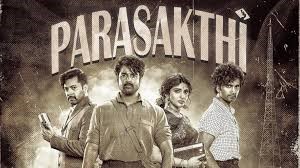
Most Indian films fade with time.
Parasakthi (1952) didn’t.
This Parasakthi movie review isn’t about nostalgia or black-and-white aesthetics. It’s about why this film still feels more dangerous, more honest, and more politically sharp than most modern releases.
It didn’t just entertain — it attacked.
Religion, blind faith, social hypocrisy, and political silence were all dragged into the open and slapped across the face.
And here’s the uncomfortable truth:
If Parasakthi released today, it wouldn’t trend for its art — it would trend for the outrage.
Indian cinema keeps chasing mass appeal and safe formulas — and that’s exactly why bold films like Parasakthi feel even more radical today. We already see audiences drifting away from shallow storytelling, especially when movies stop reflecting real issues (as discussed in this internal analysis:
Bollywood Is Losing Its Audience).
Parasakthi reminds us that cinema once had teeth.
This Wasn’t a Movie. It Was a Warning.
A proper Parasakthi movie review has to admit one thing:
This film was never meant to make people feel comfortable.
Sivaji Ganesan’s character doesn’t worship tradition — he questions it.
He doesn’t respect authority blindly — he challenges it.
He doesn’t stay silent — he exposes.
In an era where questioning religion was risky, this film went straight for the throat.
Temples weren’t shown as sacred spaces — they were shown as places of exploitation.
Priests weren’t portrayed as holy — they were shown as human and flawed.
That alone was enough to shake conservative society.
For historical context, Parasakthi is widely considered one of the most politically influential films in Indian cinema history
(Parasakthi on Wikipedia).
Why Parasakthi Was “Dangerous”
This Parasakthi movie review wouldn’t be honest without addressing why the film scared people.
It didn’t just talk about social issues.
It took sides.
It stood with:
- The poor
- The exploited
- The silenced
And it openly criticised:
- Religious hypocrisy
- Gender injustice
- Social elitism
Back then, this wasn’t “bold storytelling.”
It was political rebellion.
The film was closely linked to the Dravidian movement and helped spread rationalist ideas among the masses
(Dravidian Movement Explained).
People weren’t just watching a movie.
They were absorbing a message.
Sivaji Ganesan Didn’t Act. He Declared War.

Every serious Parasakthi movie review agrees on one thing:
Sivaji Ganesan didn’t just perform — he confronted society.
His dialogues weren’t written to entertain.
They were written to provoke.
Every monologue felt like a courtroom speech against social hypocrisy.
And people listened.
This film didn’t make Sivaji a star.
It made him a symbol.
His debut in Parasakthi is still considered one of the most powerful introductions in Indian film history
(Sivaji Ganesan Filmography).
If Parasakthi Released Today, People Would Lose Their Minds
Modern audiences love “bold cinema” — until it gets too real.
Parasakthi doesn’t sugarcoat:
- Religious exploitation
- Male dominance
- Social silence
- Emotional manipulation
If this Parasakthi movie review were about a 2025 release, social media would be on fire.
Headlines would scream “OFFENSIVE.”
Think pieces would argue “FREEDOM OF EXPRESSION.”
The same film that once awakened minds would now be labelled “controversial content.”
Funny how that works.
Why Gen Z Should Actually Care
This isn’t just an old black-and-white movie collecting dust.
Parasakthi talks about:
- Questioning authority
- Breaking blind faith
- Standing up for yourself
- Calling out social lies
Sounds pretty modern, right?
The difference?
Today, we tweet about it.
Back then, they made films about it.
That’s why Parasakthi still deserves attention from a new generation.
Final Verdict
This Parasakthi movie review isn’t here to praise visuals or nostalgia.
Parasakthi isn’t comfortable.
It isn’t polite.
It isn’t safe.
And that’s exactly why it still matters.
It reminds us that cinema isn’t just about romance, fights, and songs.
It can be a weapon.
A mirror.
A voice.
A challenge.
Most movies want your attention.
Parasakthi demands your thinking.
FAQs
Why is Parasakthi still talked about today?
Because Parasakthi didn’t just tell a story — it challenged religion, power, and social hypocrisy. Most films play safe. This one didn’t.
Was Parasakthi a controversial movie?
Yes, and that’s why it mattered. It openly criticised religious exploitation and social injustice at a time when silence was expected.
Would Parasakthi face backlash if released today?
Absolutely. Social media would explode with outrage, debates, and cancellation attempts. The themes are still uncomfortable for many.
Why is Sivaji Ganesan’s role in Parasakthi iconic?
His performance wasn’t just acting — it was a social statement. His dialogues felt like courtroom speeches against injustice.
Is Parasakthi relevant for Gen Z?
Yes. The film is about questioning authority, rejecting blind faith, and standing up for truth — exactly what modern youth care about.
What made Parasakthi different from other films of its time?
It wasn’t designed for comfort or escapism. It was designed to provoke, educate, and disturb social norms.
1 thought on “Parasakthi Movie Review: The Film That Would Break the Internet If Released Today”