
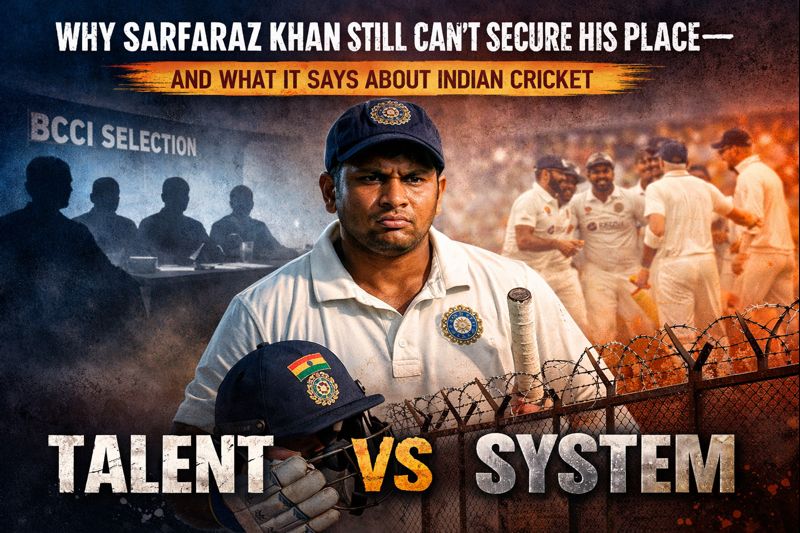
Indian cricket loves to preach one simple rule: score runs and you’ll get your chance.
Sarfaraz Khan followed that rule so obsessively that he broke it.
And that’s exactly the problem.
Because when someone like Sarfaraz Khan does everything right and still can’t lock down his place, it exposes an ugly truth Indian cricket doesn’t like admitting — this system doesn’t just reward performance, it rewards comfort.
Sarfaraz Khan Didn’t Knock on the Door — He Kicked It In
Let’s get the boring part out of the way quickly: the runs were never the issue.
Sarfaraz Khan didn’t just score in domestic cricket, he dominated it. His Ranji Trophy numbers weren’t normal. They were embarrassing — for bowlers and for selectors who kept pretending they needed “more proof.”
Season after season, the message was the same:
- He’s doing it again.
- And again.
- And again.
At some point, ignoring that level of dominance stops being caution and starts looking like avoidance.
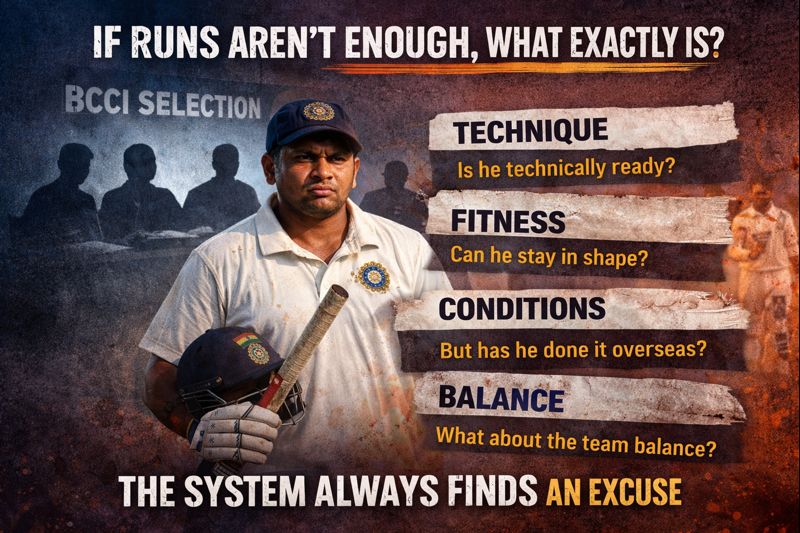
If Runs Aren’t Enough, What Exactly Is?
Here’s where the excuses started stacking up.
First, it was technique.
Then fitness.
Then overseas conditions.
Then team balance.
Then “long-term vision.”
Funny how these filters magically appear for some players and disappear for others.
Sarfaraz Khan became a walking inconvenience — a player whose performances kept ruining carefully planned narratives. And Indian cricket hates nothing more than being forced into a decision it didn’t script.
Selection in India Is About Narrative, Not Merit
This is the part fans don’t like hearing.
Indian cricket selections today are not purely merit-based. They’re narrative-based. The system prefers players who:
- Fit a clean image
- Are easy to back publicly
- Don’t raise uncomfortable questions
Sarfaraz Khan doesn’t fit that mould.
He isn’t a launch-ready star.
He isn’t polished for headlines.
His journey isn’t Instagram-friendly.
And because of that, he’s always treated like a temporary solution — never a long-term plan.
Even His India Debut Didn’t End the Doubt
When Sarfaraz Khan finally earned his India Test cap, it should’ve been the end of the debate. Instead, it felt like the beginning of a new one.
Even after his debut — which came far later than it should have, as confirmed when he finally earned his Test call-up — the trust still felt fragile.
One quiet stretch and the whispers returned.
One missed chance and patience evaporated.
Compare that with how long others are backed through repeated failures. The contrast is uncomfortable — and impossible to ignore.
The System Always Has an Explanation (For Itself)
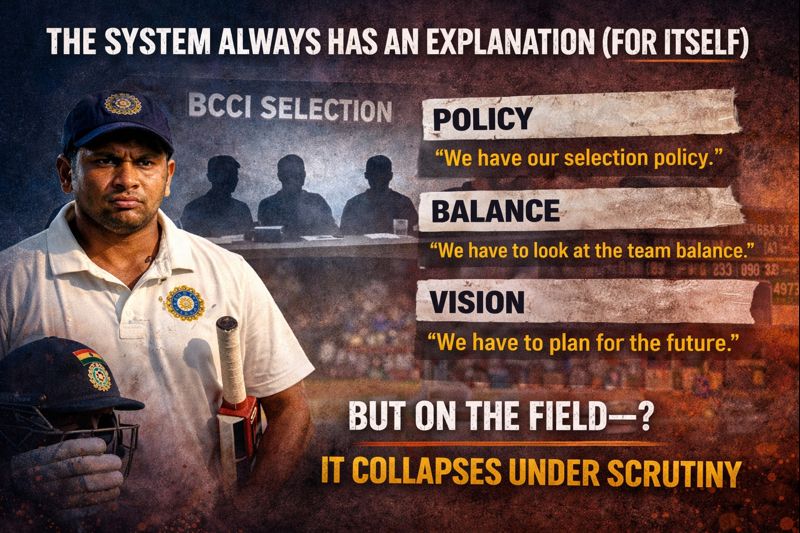
Whenever this topic gets loud, selectors hide behind vague statements about “policy” and “balance.” You’ve heard it before. You can even read them defending it in pieces like this explanation of India’s selection logic.
It sounds reasonable on paper.
But on the field? It collapses under scrutiny.
Because if domestic cricket is not the strongest indicator for Test selection, then what exactly is its purpose? ESPNcricinfo itself has questioned this gap in pieces like why Ranji runs don’t always translate into India caps.
Sarfaraz Khan isn’t an exception — he’s the proof that the system is confused about what it actually values.
What Sarfaraz Khan’s Case Really Says About Indian Cricket
It says Indian cricket:
- Loves underdogs — once they’re safe to love
- Celebrates grind — but prefers polish
- Talks about domestic cricket — without fully trusting it
Sarfaraz Khan didn’t fail Indian cricket.
Indian cricket failed to be honest about its priorities.
The Question Nobody Wants to Answer
If Sarfaraz Khan — with numbers, consistency, and resilience — can still feel expendable…
Then what hope does domestic cricket actually offer?
Because right now, it feels less like a pathway and more like a holding zone where only certain players are allowed to graduate.
Final Word
Sarfaraz Khan isn’t fighting bowlers anymore.
He’s fighting perception.
He’s fighting comfort.
He’s fighting a system that hates being forced into accountability.
And until Indian cricket learns to back performances without hesitation or hierarchy, Sarfaraz won’t be the last name this debate circles around.
Just the one that made it impossible to ignore.
FAQs
Why is Sarfaraz Khan still not a regular in the Indian team?
Because Indian cricket doesn’t operate purely on performance. Sarfaraz Khan’s domestic dominance made selection unavoidable — but not trust automatic. The system still seems unsure how to fully commit to a player who doesn’t fit its preferred narrative.
Has Sarfaraz Khan failed at the international level?
No — and that’s the frustrating part. Sarfaraz Khan hasn’t been given enough consistent opportunities to even be judged fairly. One quiet series shouldn’t outweigh years of domestic excellence, yet that’s often how Indian cricket works.
Do domestic runs still matter in Indian cricket?
They matter — selectively. Sarfaraz Khan’s case shows that while domestic cricket is praised publicly, it isn’t always trusted when it challenges pre-decided plans. Ranji Trophy performances open the door, but they don’t always secure the seat.
Is Sarfaraz Khan being treated unfairly by selectors?
“Unfair” might sound harsh, but “unevenly” is undeniable. Compared to others who’ve been backed through extended failures, Sarfaraz Khan’s leash has always been noticeably shorter — despite stronger numbers.
What does Sarfaraz Khan’s situation reveal about Indian cricket?
It reveals a system that prefers predictability over pressure. Sarfaraz Khan forces uncomfortable questions — about merit, bias, and trust — and systems rarely like being questioned from within.
Can Sarfaraz Khan still build a long Test career?
Absolutely — if Indian cricket allows it. Talent was never the issue. Consistent backing is. Without it, even the best domestic performers risk becoming footnotes instead of fixtures.
Is Sarfaraz Khan the last player to face this problem?
Not at all. Sarfaraz Khan is just the most visible example of a deeper issue — where exceptional domestic performers still have to fight perception long after they’ve proven ability.