
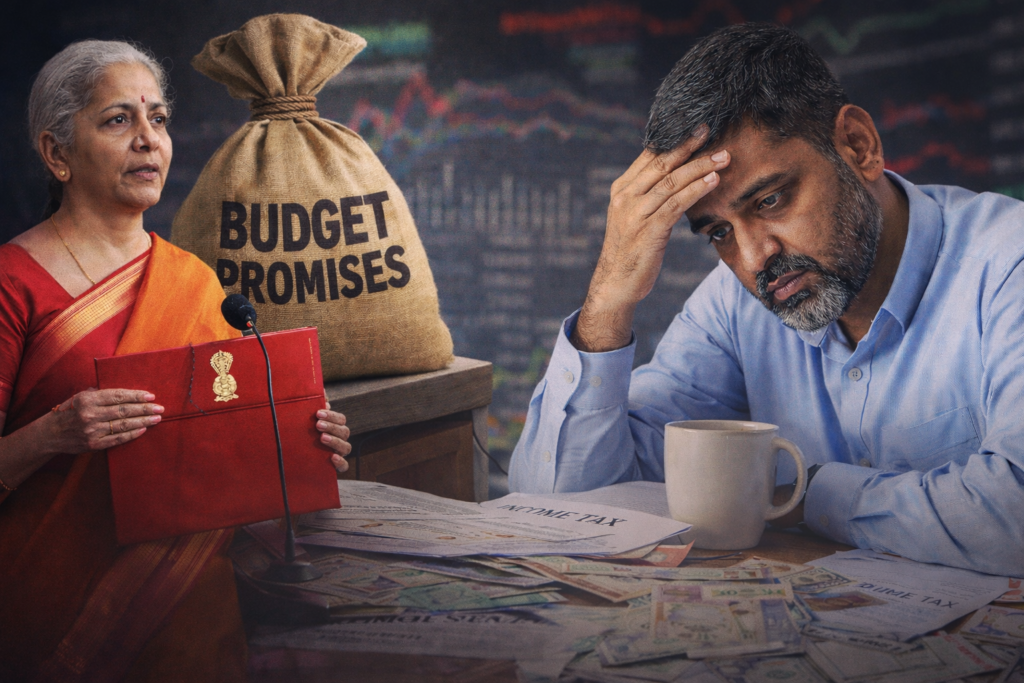
Every year, it’s the same ritual.
Finance Minister stands up.
Headlines scream “big relief,” “middle class focus,” “growth-driven Budget.”
And salaried Indians sit there thinking: maybe this time it’s actually for us.
It never is.
On paper, Budget promises for salaried Indians always look generous. In real life, nothing changes — except prices, which somehow always go up faster than salaries.
This isn’t anger anymore. It’s exhaustion.
The Language of the Budget Is Designed to Sound Comforting

If you’ve watched enough Budgets, you’ll notice a pattern.
Words like:
- relief
- support
- incentives
- boost to consumption
They sound reassuring. They’re supposed to.
But these promises are framed in a way that sounds inclusive while doing very little for people on fixed salaries. The salaried class doesn’t benefit from vague announcements, long-term roadmaps, or sector-specific incentives.
We live month to month. Roadmaps don’t pay EMIs.
Where Budget Promises Actually Break Down for Salaried Indians
Let’s get brutally honest.
Salaried Indians are the easiest group to tax and the hardest group to impress.
You can’t hide income.
You can’t delay taxes.
You can’t reclassify earnings.
So when Budget promises for salaried Indians come wrapped in phrases like “optional tax regime” or “rationalisation,” what it really means is this:
You’re paying first.
Benefits may come later.
And inflation will cancel them out anyway.
Even when there is “relief,” it’s often:
- Too small to matter
- Offset by rising costs
- Locked behind conditions most people can’t optimise
Inflation Is the Silent Budget Killer Nobody Wants to Admit
This is where the disconnect becomes obvious.
A small tax tweak looks decent in a press conference.
But in real life?
- Rent goes up
- School fees jump
- Health insurance premiums spike
- Daily expenses quietly creep higher
According to data from the Reserve Bank of India, household inflation expectations consistently remain higher than official comfort levels. Salaried people feel it every single month.
So even when Budget promises for salaried Indians include “savings” on paper, inflation eats it before the next appraisal cycle.
That’s not relief. That’s illusion.
The Middle Class Isn’t Asking for Freebies
This part gets misunderstood on purpose.
Salaried Indians are not demanding handouts. They’re not asking for subsidies or giveaways. They’re asking for fair treatment.
What they get instead is:
- Higher indirect taxes
- Shrinking purchasing power
- Benefits that favor those with flexible incomes
When policymakers talk about “consumption-led growth,” they forget one thing:
You can’t consume confidently when your income is fixed and your expenses aren’t.
Who Actually Benefits When the Budget Sounds Positive
This is uncomfortable, but it matters.
Budgets are designed to:
- Encourage investment
- Support industries
- Drive long-term growth
All valid goals.
But salaried Indians rarely fall into those priority buckets. Businesses can reinvest. Investors can plan. Corporates can restructure.
Salaried workers?
They adjust expectations.
That’s why Budget promises for salaried Indians often feel symbolic — good enough to mention, not strong enough to matter.
For official framing, you can read the government’s own explanations on the Ministry of Finance. Notice how often salaried taxpayers are mentioned — and how little detail follows.
Why This Cycle Repeats Every Year
Here’s the harsh truth no one says out loud.
Salaried Indians are predictable.
They:
- Pay taxes on time
- Rarely protest Budget outcomes
- Adjust silently
From a policy perspective, that makes them reliable, not urgent.
So every year, Budget promises for salaried Indians are crafted to sound empathetic without changing the structure. The emotional box is checked. The economic reality stays the same.
The Emotional Cost Nobody Calculates
This isn’t just about money.
It’s about the feeling that:
- Hard work isn’t translating into security
- Stability is becoming fragile
- “Doing everything right” isn’t enough anymore
That’s why these Budgets don’t just disappoint — they demotivate.
And that’s the real failure.
The Bottom Line
Budget promises for salaried Indians are not lies.
They’re carefully worded half-truths.
They sound good because they’re meant to.
They fail because the system isn’t designed around fixed-income reality.
Until that changes, every Budget will follow the same script:
Hope → Headlines → Acceptance → Adjustment.
And salaried Indians will keep asking the same question next year:
What did we actually get?
FAQs
Why do Budget promises for salaried Indians feel ineffective?
Because most Budget announcements focus on long-term growth, sector incentives, or indirect benefits. Salaried Indians, with fixed incomes and rising expenses, rarely see immediate or meaningful relief.
Does the Union Budget really help the salaried middle class?
In limited ways. Any tax relief is often too small and quickly offset by inflation, higher living costs, and increased indirect taxes.
Why is inflation a bigger issue than tax relief for salaried Indians?
Even when taxes are adjusted, rising costs like rent, healthcare, education, and daily expenses reduce real income, making Budget relief feel invisible.
Who benefits most from Budget announcements in India?
Businesses, investors, and capital-intensive sectors benefit more due to flexibility in income planning and access to incentives not available to salaried earners.
Will future Budgets improve things for salaried Indians?
Only if policies start addressing fixed-income realities directly. Until then, Budget promises for salaried Indians are likely to remain symbolic rather than impactful.