
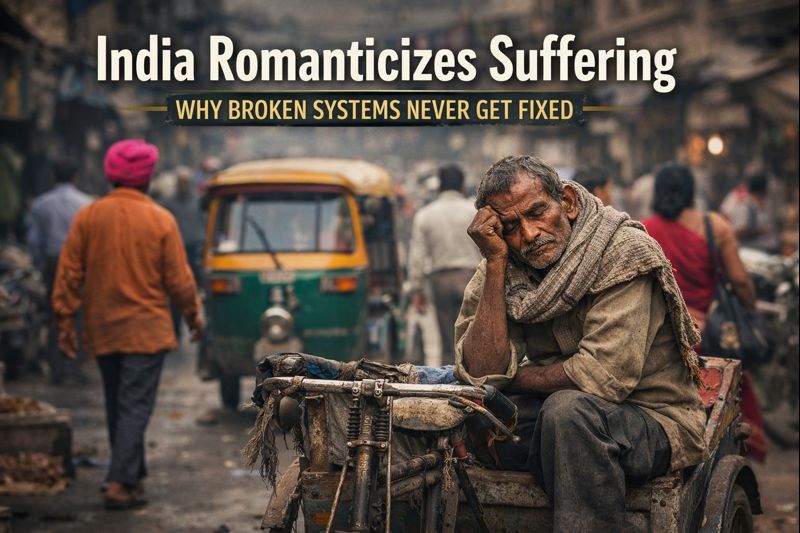
Indians are resilient. That part is undeniable. We survive power cuts, overcrowded cities, endless competition, low pay, and constant uncertainty. We adjust. We endure. We keep moving.
But somewhere along the way, India romanticizes suffering so deeply that resilience stopped being a strength — and quietly became an excuse.
An excuse for broken systems.
An excuse for inefficiency.
An excuse for exploitation.
Instead of fixing what’s clearly failing, India teaches people to accept pain as character-building. We’re told struggle makes us stronger, hardship is normal, and suffering is just “how life works.” What sounds inspiring on the surface slowly trains people to tolerate things they never should have.
And that’s the uncomfortable truth most people avoid.
When India Romanticizes Suffering Instead of Fixing Systems
In India, suffering isn’t treated as temporary. It’s treated as a virtue.
Long work hours? That’s how success is earned.
Low pay? At least you have a job.
Broken infrastructure? Learn to adjust.
Mental exhaustion? Everyone goes through this.
India consistently ranks among countries with some of the longest working hours and rising burnout levels, a reality highlighted in reports by the International Labour Organization on work stress and productivity.
Over time, this mindset becomes normal. Instead of questioning why systems don’t work, people are taught to endure them silently. Complaining is seen as weakness. Asking for better is labeled entitlement.
Struggle stops being questioned — it starts being celebrated.
Where Indians Learn to Romanticize Suffering
This mentality isn’t accidental. It’s taught early and reinforced everywhere.
At Home
Parents often say it with love, but the message is clear:
“We struggled, so you should too.”
Sacrifice is glorified. Financial stress is normalized. Money conversations are avoided. Children grow up believing pain is proof they’re doing life “right,” not a sign that something needs fixing.
In Schools and Colleges
The education system rewards endurance, not understanding. Students are pushed through outdated syllabi, ruthless competition, and pressure-heavy environments while being told stress builds discipline.
Global education bodies like UNESCO have repeatedly pointed out how rote learning systems prioritize survival over real skill development — yet reform remains painfully slow.
At Work
Indian workplaces often confuse exploitation with loyalty.
Late nights equal dedication.
Burnout equals commitment.
Understaffing equals efficiency.
The long-term damage of hustle culture has been examined by Harvard Business Review’s reporting on burnout and productivity, which shows that chronic overwork reduces performance instead of improving it. Still, employees who question this culture are labeled lazy or ungrateful.
In Society
Social media finishes the job. Hustle reels go viral. Struggle stories are applauded. Nobody asks why grinding has become necessary just to survive.
Who Actually Benefits When India Romanticizes Suffering?
Here’s the uncomfortable truth: romanticized suffering protects broken systems.
Bad employers don’t need to improve.
Inefficient institutions avoid accountability.
Systemic failures get blamed on individuals.
When India romanticizes suffering, responsibility quietly shifts away from institutions and lands entirely on people, making failure feel personal instead of structural.
If pain is destiny, pressure disappears from those in power.
The Most Dangerous Lie Indians Are Sold
“If you failed, you didn’t work hard enough.”
This lie shifts blame away from systems and dumps it onto individuals. It also hides deeper issues like financial illiteracy among India’s middle class, where people are never taught how money actually works, yet are judged harshly for struggling.
Hard work matters — but pretending systems don’t is dishonest. Not every failure is personal. Sometimes the system itself is broken.
But admitting that would require fixing it. And fixing things is harder than telling people to endure.
This Isn’t Anti-India — It’s Pro-Indian
Criticism isn’t hatred. Silence is.
Pointing out broken systems doesn’t insult the country — it respects its people. Indians deserve systems that work, not motivational speeches about tolerance and sacrifice.
Struggle should exist only where growth demands it — not where incompetence hides behind tradition.
The Ending India Needs to Hear
Struggle can build strength — but only when it’s temporary.
When suffering becomes a lifestyle, it stops being noble and starts being abusive. As long as India romanticizes suffering, broken systems will survive without pressure to change.
India doesn’t need more resilient citizens.
It needs better systems.
Because pain shouldn’t be a tradition.
And survival shouldn’t be mistaken for success.
FAQs
Why does India romanticize suffering?
India romanticizes suffering because resilience is often valued more than reform. Instead of fixing broken systems, hardship is framed as character-building, making people accept inefficiency as normal.
Is romanticizing suffering harmful for the middle class?
Yes. When India romanticizes suffering, the middle class absorbs rising costs, job pressure, and burnout while being told to “adjust” instead of demanding better systems.
How does this mindset affect Indian work culture?
It normalizes long hours, low pay, and burnout. Employees are praised for endurance, not productivity, which allows poor management and toxic work culture to continue.
Does India romanticize suffering in education too?
Absolutely. Academic stress, rote learning, and extreme competition are treated as necessary struggles rather than signs of a broken education system.
Who benefits when India romanticizes suffering?
Broken institutions, inefficient governance, and exploitative employers benefit the most. When people blame themselves, systems avoid accountability.
Is criticizing this mindset anti-India?
No. Criticizing why India romanticizes suffering is pro-India. Real progress comes from fixing systems, not glorifying pain.
What’s the alternative to glorifying struggle?
Struggle should be temporary and purposeful. Strong systems, fair wages, better education, and accountability should replace blind endurance.
Why do middle-class Indians still feel broke despite working hard?
Because income growth hasn’t matched inflation, taxes, EMIs, and rising living costs—while systemic failures are ignored and individuals are blamed.
2 thoughts on “India Doesn’t Fix Broken Systems — It Teaches People to Romanticize Suffering”