
If you’ve been scrolling through news or social media lately, you’ve probably seen the same words again and again: Nipah Virus, quarantine, hospitals, alerts, fear.
And instantly, your brain goes: Not again. Please, not again.
After COVID, Indians are traumatised by health emergencies. So the moment another virus shows up, panic spreads faster than facts. WhatsApp forwards start flying. Fake “inside reports” appear. Suddenly, everyone is a self-declared doctor.
But let’s slow down.
Is the Nipah Virus outbreak in India really something to be terrified of right now?
Or is this another case of information turning into hysteria?
Let’s talk honestly.
What Exactly Is the Nipah Virus? (No Medical Jargon)
The Nipah Virus is not new. It’s been around for decades and has caused outbreaks in India, Bangladesh, and Malaysia before.
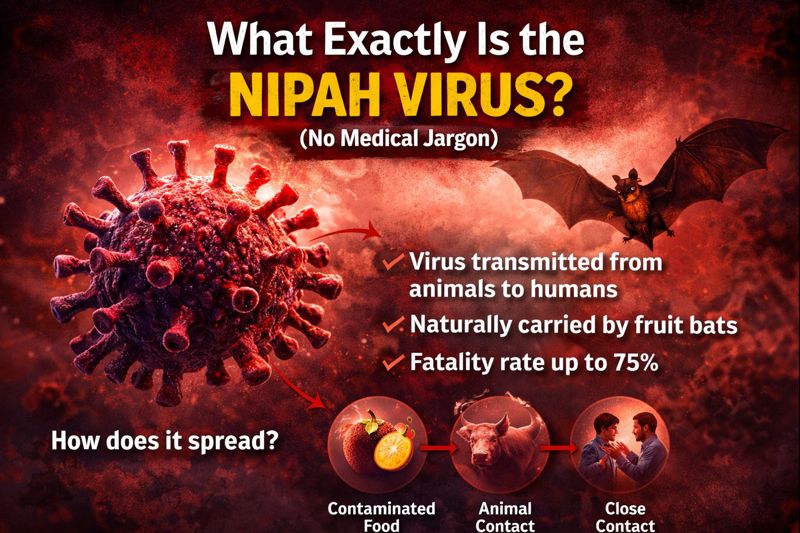
It is a virus that jumps from animals to humans — mainly through fruit bats. Humans can get infected by:
- Eating food contaminated by bats
- Coming into contact with infected animals
- Being in close contact with an infected person
According to the World Health Organization’s Nipah overview, the virus can cause severe fever, breathing problems, and in serious cases, inflammation of the brain.
The scary part?
Its fatality rate has ranged from 40% to 75% in different outbreaks.
That’s high. No exaggeration.
What’s Happening in India Right Now?
Recently, confirmed cases of the Nipah Virus were reported in West Bengal, including healthcare workers who were treating a patient.
Authorities immediately started:
- Contact tracing
- Quarantining close contacts
- Testing samples
- Strengthening hospital protocols
Reports from major outlets show that most close contacts have tested negative so far, and there is no confirmed large-scale community spread yet.
This matters.
It means the situation is being monitored early — not after it explodes.
And early action saves lives.
Why People Are So Scared of Nipah
Let’s be honest. This fear isn’t random.
Three big reasons:
High Death Rate
Unlike flu or mild COVID variants, Nipah can be deadly if it becomes severe.
The CDC’s official Nipah factsheet clearly states that the virus can lead to fatal encephalitis and respiratory failure.
No Vaccine Yet
There is currently no approved vaccine for Nipah.
Doctors mainly provide supportive care.
Medical experts at the Cleveland Clinic confirm that treatment focuses on managing symptoms, not curing the virus.
COVID Trauma
After lockdowns, oxygen shortages, and hospital chaos, people don’t trust “Don’t worry” statements anymore.
So when a new virus appears, fear feels automatic.
Is This Another COVID-Style Disaster?
Short answer: No. Not based on current data.
Here’s why:
Nipah vs COVID
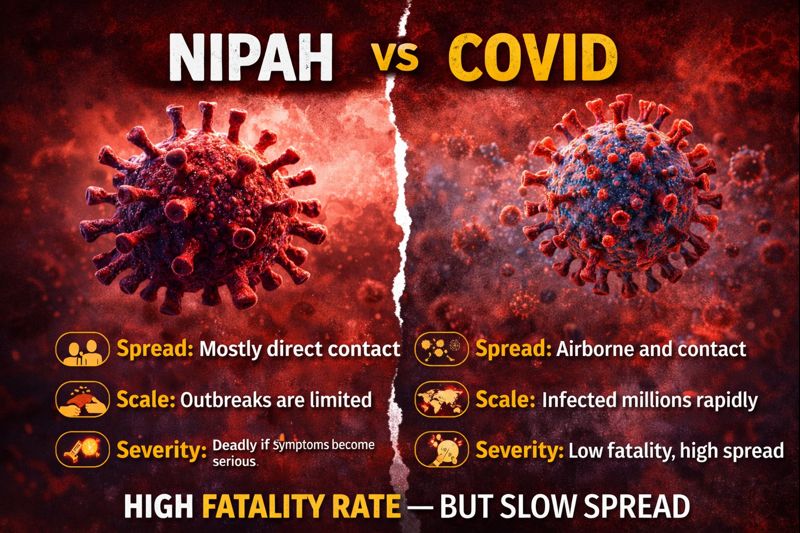
- COVID spread through air easily.
- Nipah spreads mostly through direct contact.
- COVID infected millions quickly.
- Nipah outbreaks are usually limited and slow.
- COVID had low death rate but huge spread.
- Nipah has high death rate but low spread.
That difference is massive.
Nipah is dangerous, yes.
But it doesn’t explode across cities overnight.
That’s why most outbreaks in India were contained before becoming national crises.
So… Should You Panic?
No.
Panic helps nobody.
But ignoring it is also stupid.
The right approach is: alert, not afraid.
Right now:
- Cases are limited
- Monitoring is active
- Health teams are alert
- No mass transmission reported
This is how outbreaks are supposed to be handled.
When systems respond early, disasters are prevented.
What You Should Actually Do (Practical Stuff)
Not dramatic. Not paranoid. Just smart.
Maintain Hygiene
Wash hands regularly. Don’t be careless.
Be Careful With Fruits
Avoid fallen or half-eaten fruits in outbreak zones. Bats may contaminate them.
Avoid Sick Animals
Do not touch or handle sick animals.
Watch for Symptoms
If you have fever, headache, breathing trouble, or confusion — especially after contact with a patient — seek medical help immediately.
Don’t Share Rumours
WhatsApp “secret updates” are usually fake. Don’t be that person.
The Bigger Problem: Panic Culture
Every time a disease appears, the same pattern repeats:
- One case →
- 100 rumours →
- 1000 fake cures →
- Mass anxiety
People start stockpiling medicines.
Hospitals get flooded with healthy people.
Real patients struggle.
This happened during COVID.
It’s starting again.
And it’s dangerous.
Information saves lives.
Misinformation kills them.
What This Outbreak Really Means
Let’s be brutally honest.
The Nipah Virus is serious.
It deserves attention.
It deserves caution.
But right now, it does NOT justify mass panic.
India has dealt with Nipah before — in Kerala, in West Bengal, in small clusters — and controlled it.
As long as authorities remain proactive and people remain sensible, this will stay contained.
The real enemy isn’t just the virus.
It’s fear without facts.
Bottom Line
Be informed.
Be alert.
Be responsible.
But don’t let anxiety run your life.
Because panic spreads faster than Nipah ever will.
FAQs
What is the Nipah Virus?
The Nipah Virus is a zoonotic virus that spreads from animals to humans, mainly through fruit bats. It can cause fever, breathing problems, and brain inflammation in severe cases.
Is the Nipah Virus spreading in India right now?
Currently, Nipah cases in India are limited to small clusters, mainly in West Bengal. Authorities are actively tracing contacts and monitoring the situation.
How dangerous is the Nipah Virus?
Nipah Virus has a high fatality rate compared to many other infections. However, it spreads slowly and is usually contained through early detection and isolation.
What are the main symptoms of Nipah Virus infection?
Common symptoms include fever, headache, vomiting, sore throat, breathing difficulty, and confusion. In severe cases, it can lead to encephalitis.
Can Nipah Virus spread from person to person?
Yes, Nipah can spread through close contact with bodily fluids of an infected person, especially in healthcare settings.
Is there a vaccine or treatment for Nipah Virus?
There is currently no approved vaccine for Nipah Virus. Treatment mainly focuses on managing symptoms and providing supportive medical care.