
For millions of people, Bashir Badr was not just a poet. He was that one voice that somehow understood heartbreak before you experienced it, loneliness before you could explain it, and hope when life seemed to be falling apart.
Now, that voice has fallen silent.
Celebrated Urdu poet Bashir Badr has passed away at the age of 91 in Bhopal after a prolonged illness, marking the end of one of the most influential chapters in modern Urdu poetry. His death has triggered an outpouring of grief from readers, writers, artists, and admirers across India and beyond.
Yet calling this merely the death of a poet feels incomplete.
Because Bashir Badr was never confined to books.
His words lived in college notebooks, wedding cards, WhatsApp statuses, political speeches, radio programs, and countless conversations between people trying to put their emotions into words.
Bashir Badr Dies At 91, But His Poetry Had Already Become Immortal
News of Bashir Badr’s death spread quickly across social media and literary circles. Tributes poured in from readers who grew up reciting his couplets and from younger audiences who discovered him through the internet. Many described him as the poet who made Urdu poetry feel personal, accessible, and deeply human.
Unlike many literary figures whose work remains limited to academic discussions, Bashir Badr’s poetry entered everyday life.
Even people who never considered themselves poetry lovers often knew his lines by heart.
That rare connection is what made him different.
His verses never felt distant or difficult. They felt like conversations.
And perhaps that is why his passing feels personal to so many people today.
The Journey Of Urdu Poet Bashir Badr
Born on February 15, 1935, Bashir Badr’s journey began in what is now Uttar Pradesh. Over the decades, he would become one of the most recognizable voices in Urdu literature. He completed his higher education at Aligarh Muslim University and later worked in academics before fully establishing himself as a major literary figure.
His relationship with poetry started early.
According to published accounts, he began writing at a very young age and eventually developed a style that blended traditional Urdu elegance with modern emotions.
Readers did not need a literature degree to understand him.
That accessibility became his greatest strength.
While many poets wrote for literary circles, Bashir Badr wrote for ordinary people dealing with love, loss, separation, memories, and the everyday struggles of life.
The Tragedy That Changed His Life Forever
One of the most defining moments in Bashir Badr’s life came during the 1987 Meerut riots.
His house was destroyed and a large portion of his unpublished literary work was lost forever. For many writers, such a loss could have ended a creative career.
But Bashir Badr continued writing.
What is remarkable is that despite experiencing such personal devastation, his poetry rarely became bitter. Instead, it continued to explore humanity, relationships, forgiveness, and emotional resilience.
That ability to rise above personal tragedy became one of the reasons readers admired him so deeply.
He had every reason to become cynical.
He chose poetry instead.
Why Bashir Badr Connected With Multiple Generations
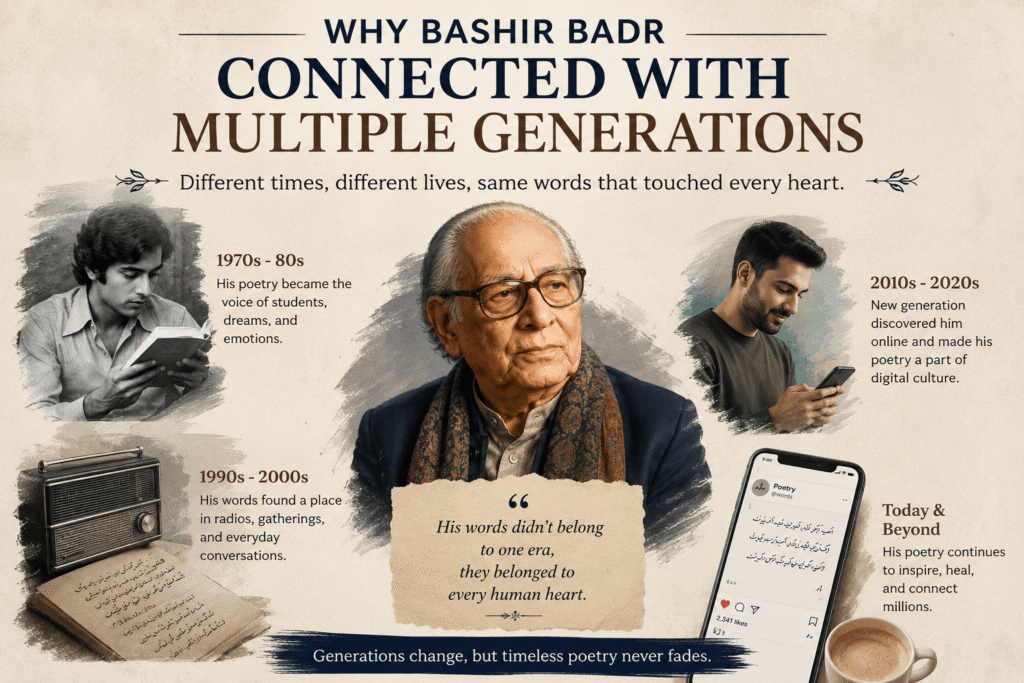
Most poets become associated with a particular era.
Bashir Badr somehow belonged to all of them.
People who discovered him in the 1970s continued reading him decades later. Young readers discovering Urdu poetry online still found his work relatable.
The reason is simple.
Human emotions change very little.
Love still hurts.
Memories still linger.
Goodbyes still leave questions unanswered.
And Bashir Badr wrote about these experiences with extraordinary simplicity.
His poetry was not trying to impress readers.
It was trying to reach them.
That distinction made all the difference.
According to literary observers, his work became one of the strongest bridges between traditional Urdu poetry and modern audiences.
More Than A Poet, A Cultural Phenomenon
There are very few poets whose words escape literary gatherings and enter mainstream culture.
Bashir Badr was one of them.
His couplets were quoted by politicians, journalists, actors, television presenters, and ordinary citizens alike. Over the years, his lines appeared in public speeches, newspaper columns, television programs, and social media posts.
That level of cultural influence is rare.
Even people who could not identify the author often recognized the words.
In many ways, Bashir Badr achieved something every writer dreams about.
His poetry stopped belonging to him and started belonging to the people.
The Final Years Of Bashir Badr
In recent years, Bashir Badr had largely stayed away from public life because of health issues.
Reports indicate that he had been battling dementia for a prolonged period. The illness gradually affected his memory, creating a heartbreaking contrast for a man whose words had helped millions remember their own emotions.
Readers often found that reality difficult to accept.
A poet known for preserving memories through verse was himself struggling to hold onto them.
Yet even as his health declined, admiration for his work never faded.
His poetry continued to circulate widely, finding new readers across digital platforms and literary communities.
The Legacy Bashir Badr Leaves Behind
Whenever a major literary figure dies, people ask the same question.
What remains?
In Bashir Badr’s case, the answer is simple.
Everything.
His books remain.
His ghazals remain.
His influence remains.
Most importantly, the emotional connection readers feel with his poetry remains.
Generations from now, people will still discover his work for the first time and feel as though it was written specifically for them.
That is the true measure of literary greatness.
Not awards.
Not headlines.
Not social media trends.
A writer becomes immortal when their words continue speaking long after they are gone.
By that standard, Bashir Badr achieved immortality years ago.
A Farewell To The Poet Who Understood Human Emotions
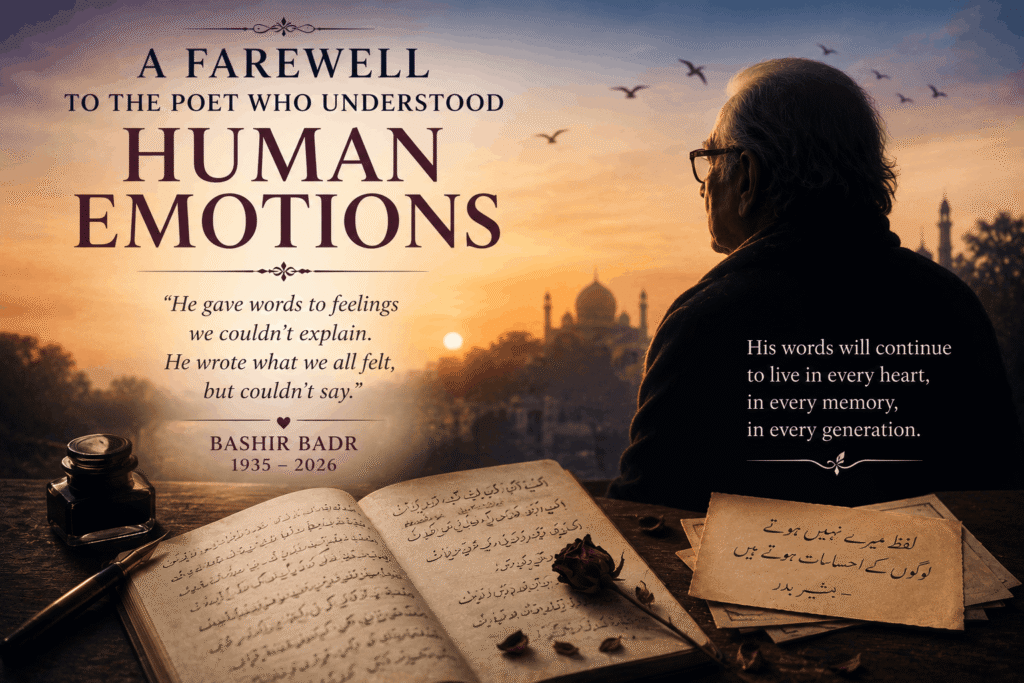
The death of Bashir Badr is undoubtedly a huge loss for Urdu literature.
But it is also a reminder of how powerful words can be.
Very few writers manage to capture the emotional experiences shared by millions of people.
Even fewer manage to do it with such grace and simplicity.
Today, readers are mourning the loss of a beloved poet.
At the same time, they are revisiting the verses that made them laugh, cry, reflect, and heal.
Perhaps that is the most fitting tribute possible.
Bashir Badr may no longer be with us, but the emotions he gave language to will continue living in every reader who finds comfort in his poetry.
And that is why his story does not end with an obituary.
It continues with every line that is remembered, shared, and passed on to the next generation.
FAQs
Who was Bashir Badr?
Bashir Badr was a celebrated Indian Urdu poet known for his emotionally powerful ghazals and poetry that resonated with readers across generations.
Did Bashir Badr die?
Yes, Bashir Badr passed away in Bhopal on May 28, 2026, at the age of 91 after a prolonged illness.
Why is Bashir Badr famous?
Bashir Badr became famous for his unique ability to express love, heartbreak, memories, and human emotions through simple yet impactful Urdu poetry.
What happened to Bashir Badr?
The legendary poet had been dealing with age-related health issues and dementia in recent years before passing away at the age of 91.
What is Bashir Badr’s literary legacy?
Bashir Badr is regarded as one of the most influential modern Urdu poets whose work helped bring Urdu poetry to mainstream audiences.
Where did Bashir Badr live?
Bashir Badr spent much of his later life in Bhopal, Madhya Pradesh, where he continued to be celebrated as a literary icon.
1 thought on “Bashir Badr Dies At 91: The Poet Whose Words Defined Generations”