
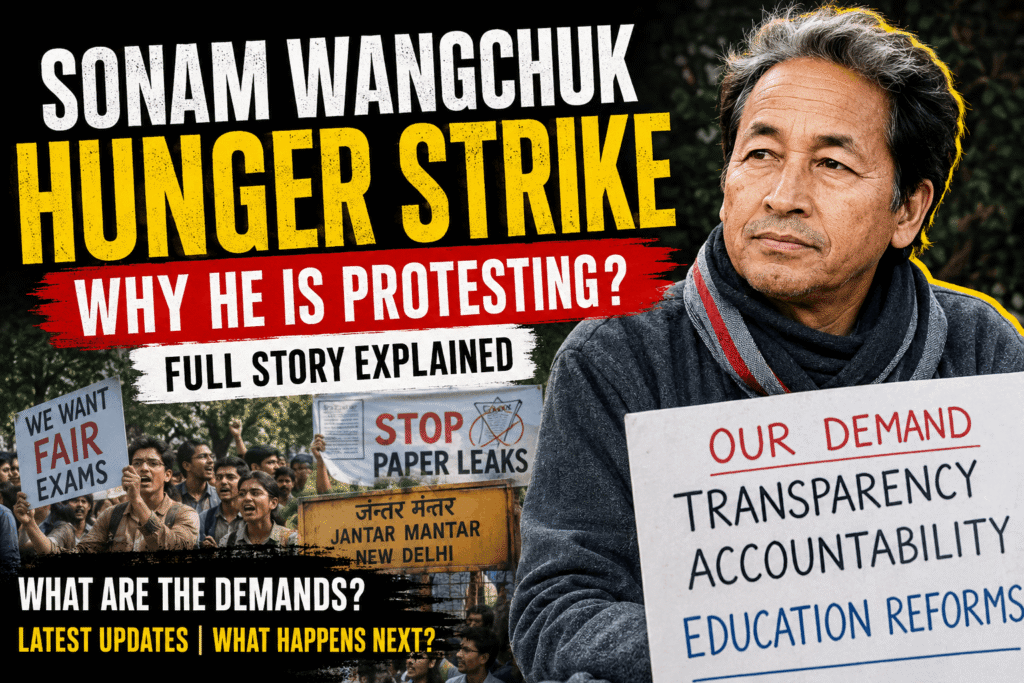
Over the past few days, Sonam Wangchuk has once again become one of the most talked-about names in India. Photos and videos from Jantar Mantar in New Delhi have spread rapidly across social media, showing the education reformer and environmental activist continuing his indefinite fast. As public concern grows over his health, many people are searching for one question: Why is Sonam Wangchuk protesting?
The Sonam Wangchuk hunger strike is about much more than one person’s protest. It has sparked a wider debate about transparency in India’s competitive examination system, public accountability, and the future of millions of students who spend years preparing for entrance exams. With the Delhi High Court seeking responses from the Centre and the Delhi Government regarding a plea for medical intervention, the issue has now moved beyond Jantar Mantar and into the national spotlight, according to the latest Times of India report on the court proceedings.
For many Indian families, this story feels personal. Whether it is a student preparing for NEET in Kota, attending coaching classes in Delhi’s Mukherjee Nagar, or studying from home in Bihar or Maharashtra, years of hard work depend on the belief that examinations are conducted fairly. That is why this protest has struck a chord with students and parents across the country.
Why Is Sonam Wangchuk on a Hunger Strike?
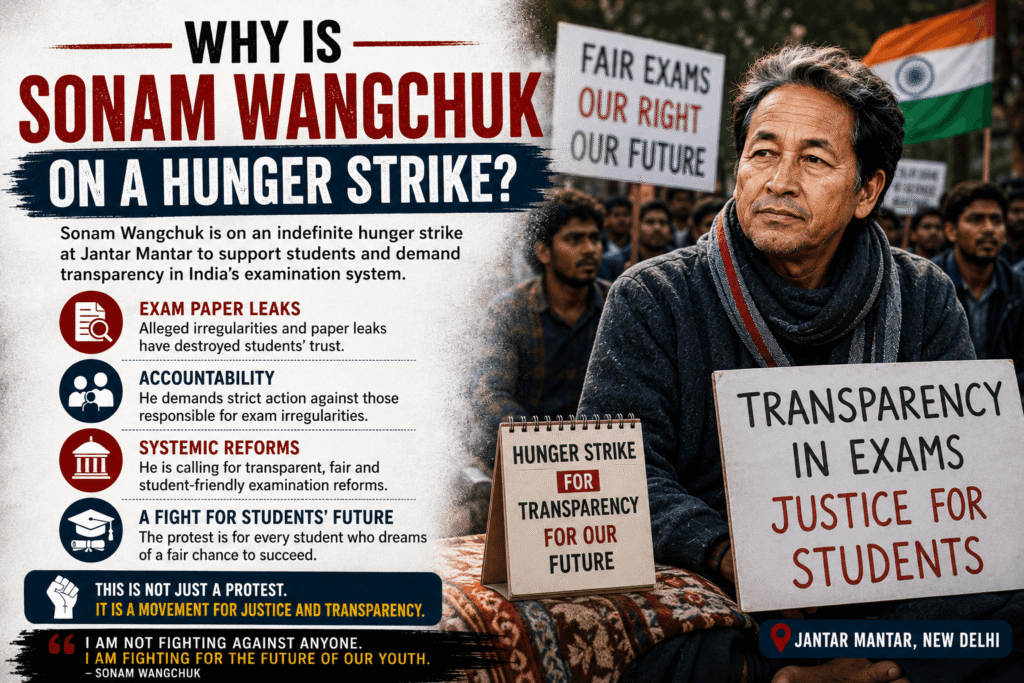
The Sonam Wangchuk hunger strike began on June 28 at Jantar Mantar. Wangchuk says he is fasting in support of a youth-led campaign demanding greater accountability over alleged examination irregularities, particularly the NEET-UG 2026 paper leak controversy.
According to a recent Reuters report on the ongoing protest, protesters are demanding the resignation of Union Education Minister Dharmendra Pradhan, strict action against those responsible for examination irregularities, and broader reforms to restore confidence in India’s education system.
The issue has resonated because competitive examinations play a life-changing role in India. In NEET-UG alone, more than two million students compete every year for a limited number of MBBS seats, making every allegation of unfairness a matter of national concern. Families often invest years of savings in coaching, hostel fees, books, and travel, hoping merit alone will determine the outcome.
Unlike many demonstrations that quickly become political, Wangchuk has repeatedly described the movement as a call for fairness, transparency, and accountability. His message has found support among many students who believe that trust in the examination system is just as important as the examinations themselves.
What Is Happening at Jantar Mantar?
Jantar Mantar has long been one of India’s most recognised venues for peaceful public demonstrations, and it has once again become the centre of national attention. Every day, students, activists, educators, and ordinary citizens have been gathering to express solidarity with Wangchuk and to highlight concerns about examination transparency.
As the fast continues, concerns over Wangchuk’s health have intensified. According to the latest Times of India health update, he has lost around 8.5 kilograms, and doctors monitoring his condition have warned that prolonged fasting could increase health risks.
The protest has also attracted support from several well-known public figures. Actors including Shabana Azmi, Swara Bhasker, Soni Razdan, Zeenat Aman, Naseeruddin Shah, Abhay Deol, and Omi Vaidya have appealed to Wangchuk to end his fast while expressing support for his campaign. Their statements have brought even greater public attention to the movement, as reported in the latest Times of India entertainment coverage.
The Sonam Wangchuk protest has also gained significant traction across X, Instagram, YouTube, and other social media platforms, where updates from Jantar Mantar continue to circulate widely. What began as a protest at a single location has now evolved into a nationwide conversation about education, accountability, and the future of India’s examination system.
By this stage, one question naturally follows: What exactly are the protesters demanding, and how could this movement influence India’s education system in the months ahead?
What Are the Protesters Demanding?
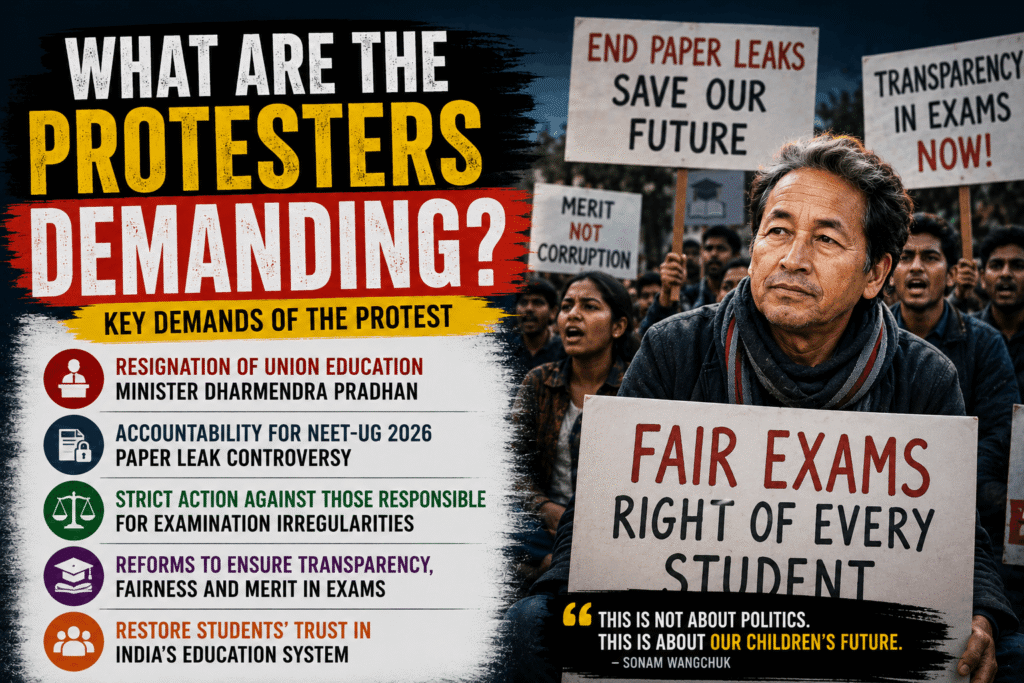
The Sonam Wangchuk protest is centred on one core message: students deserve an examination system they can trust. Protesters argue that repeated allegations of paper leaks and irregularities have damaged confidence in competitive exams, leaving many students questioning whether years of hard work are enough.
According to a recent Reuters report on the protest’s demands, demonstrators are calling for the resignation of Union Education Minister Dharmendra Pradhan, accountability for the NEET-UG 2026 paper leak controversy, strict action against those responsible for examination irregularities, and reforms to improve transparency across the education system.
For students, this debate goes beyond one examination. Every year, millions of aspirants prepare for medical, engineering, and government entrance exams, often sacrificing years of study, family time, and financial resources. Any allegation of unfairness naturally raises concerns about whether merit is being protected.
Many parents can relate to this pressure. Families regularly spend significant amounts on coaching institutes, hostel accommodation, books, and online learning platforms, hoping that dedication and hard work will lead to success. That is why the Jantar Mantar protest has connected with people far beyond Delhi.
How Has the Government Responded?
The government has not accepted the protesters’ primary demands so far, and the demonstrations continue. At the same time, the legal focus has shifted toward Wangchuk’s health after the Delhi High Court sought responses from the Centre and the Delhi Government regarding a plea requesting medical intervention during his fast. Details of the proceedings are available in the latest Times of India court report.
Doctors monitoring Wangchuk have continued to express concern as the hunger strike enters another week. While supporters believe the protest has drawn national attention to the issue, many public figures have also urged him to prioritise his health while continuing the movement through dialogue.
The protest has also triggered wider discussions about how examination-related controversies should be handled in the future. Many education experts believe stronger safeguards and faster investigations could help rebuild public confidence whenever allegations of irregularities arise.
Why Is This Protest Receiving National Attention?
There have been countless demonstrations at Jantar Mantar, but this one stands out because of who Sonam Wangchuk is. Known for his work in education, innovation, and sustainable development, Wangchuk has earned credibility across political and regional lines, making his decision to undertake an indefinite hunger strike particularly significant.
His campaign has attracted support from students, educators, environmental activists, civil society members, and several public figures. According to the latest Times of India entertainment coverage, actors including Shabana Azmi, Swara Bhasker, Soni Razdan, Zeenat Aman, Abhay Deol, Naseeruddin Shah, and Omi Vaidya have publicly expressed concern for his health while supporting his broader message.
The movement has also become one of the most discussed topics across X, Instagram, YouTube, and other social media platforms, where videos from Jantar Mantar continue to receive widespread attention. For many Indians, the discussion is no longer just about one protest. It has become a larger conversation about fairness, accountability, and trust in public institutions.
What Could Happen Next?
The coming days are expected to be crucial. If meaningful discussions take place between the protesters and the authorities, there could be progress toward resolving some of the concerns raised during the Sonam Wangchuk hunger strike. If not, public pressure is likely to grow as attention remains focused on Wangchuk’s health and the legal proceedings.
For millions of students and parents, the outcome matters because it touches on something much bigger than a single protest. It raises an important question about whether India’s examination system can continue to inspire confidence when allegations of irregularities become national headlines.
Final Thoughts

The Sonam Wangchuk hunger strike has grown into more than a demonstration at Jantar Mantar. It has become a national discussion about education, transparency, accountability, and the future of India’s competitive examination system.
Regardless of where people stand politically, the protest has highlighted concerns shared by students and parents across the country. As court proceedings continue and the government’s response evolves, the developments at Jantar Mantar will remain closely watched in the days ahead, making this one of India’s most significant public movements centred on education and institutional trust this year.
FAQs
Why is Sonam Wangchuk on a hunger strike?
Sonam Wangchuk is on a hunger strike at Jantar Mantar to support a movement demanding greater transparency in India’s examination system, accountability for alleged examination irregularities, and broader education reforms.
Where is Sonam Wangchuk protesting?
Sonam Wangchuk is holding his hunger strike at Jantar Mantar in New Delhi, one of India’s most well-known locations for peaceful public demonstrations.
What are the main demands of the Sonam Wangchuk protest?
The protesters are seeking accountability for alleged examination irregularities, stronger safeguards against paper leaks, reforms to improve transparency, and other measures aimed at restoring trust in India’s education system.
How long has Sonam Wangchuk been on a hunger strike?
According to the latest reports, Sonam Wangchuk has been on an indefinite hunger strike since June 28, and his health has become a growing concern.
Why is the Jantar Mantar protest receiving national attention?
The protest has drawn nationwide attention because it focuses on the fairness of competitive examinations and involves Sonam Wangchuk, a respected education reformer and environmental activist whose campaign has gained support from students and public figures across India.
3 thoughts on “Why Is Sonam Wangchuk on a Hunger Strike at Jantar Mantar? Here’s What the Protest Is Really About”