
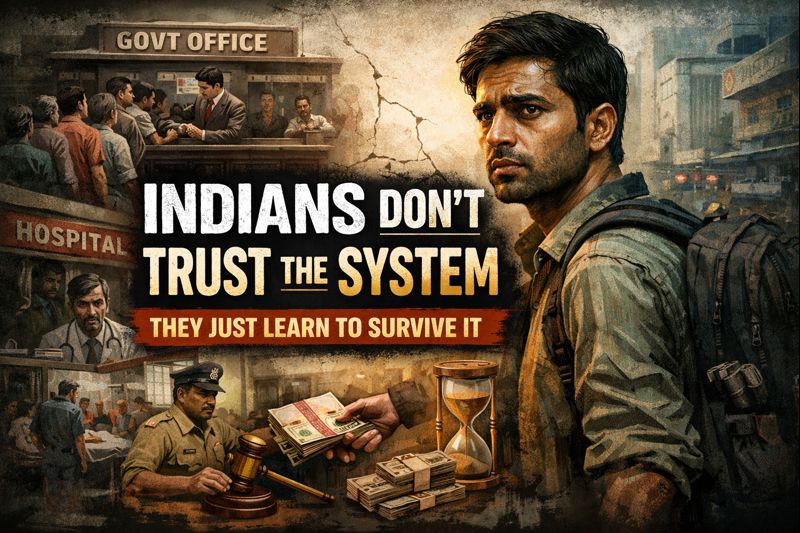
Indians Don’t Trust the System — not because they’re negative, but because experience taught them not to. In India, trust isn’t inherited. It’s slowly destroyed through endless queues, broken promises, confusing rules, and a culture that constantly tells people to “adjust kar lo.” Over time, frustration replaces faith, and survival feels more realistic than hope.
People don’t wake up one day and decide to lose trust.
The system trains them to.
And instead of rebelling, most Indians adapt — because surviving a broken system is easier than fighting one that rarely listens.
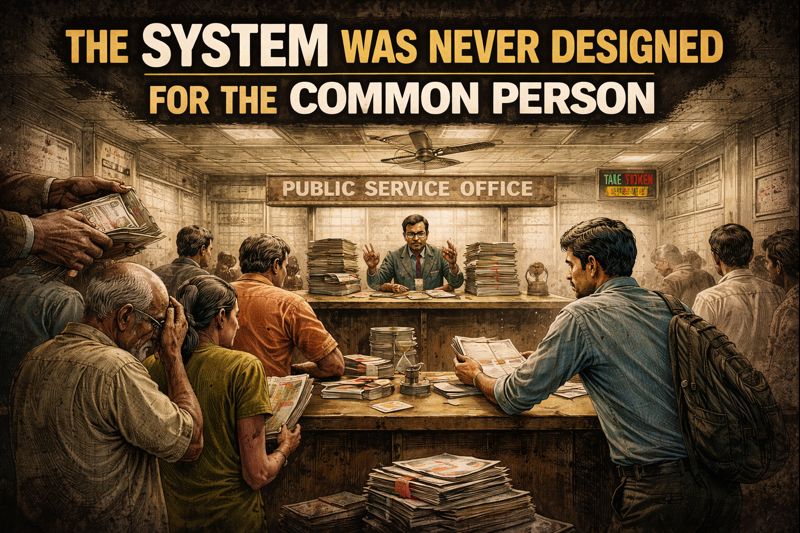
The System Was Never Designed for the Common Person
Let’s be honest.
Whether it’s:
- Government offices
- Public hospitals
- Education boards
- Police stations
- Courts
- Job sectors
Nothing feels user-friendly.
Everything feels like:
- Paperwork overload
- Rule confusion
- Long waiting
- Zero accountability
So people stop expecting fairness.
They expect frustration.
That’s exactly why Indians don’t trust the system anymore — they just prepare for disappointment.
Trust Was Replaced by “Jugaad”
In India, jugaad isn’t clever.
It’s necessary.
When systems don’t work properly, people don’t fix them —
they work around them.
You don’t trust the process.
You trust:
- Contacts
- Shortcuts
- Bribes
- “Koi jaan-pehchaan hai?”
It’s not corruption for fun.
It’s corruption for survival.
We Were Trained to Obey, Not Question
Indian education doesn’t build critical thinkers.
It builds followers.
Students are taught to:
- Memorize
- Obey
- Not question
- Not challenge
So when they grow up, they don’t demand better systems.
They just learn how to navigate broken ones.
No one asks why things are bad.
They ask how to manage.
Jobs Give Salaries, Not Security
Most Indians don’t trust the job market either.
Hard work doesn’t guarantee growth.
Loyalty doesn’t guarantee safety.
Talent doesn’t guarantee respect.
People stay silent.
Not because they’re happy —
but because survival matters more than satisfaction.
This is why Indians don’t trust the system — they tolerate it.
Healthcare Runs on Hope, Not Confidence
Public trust in healthcare is fragile.
You don’t feel protected.
You feel uncertain.
Families rely on:
- Personal references
- Known clinics
- Word-of-mouth
Not systems.
Not policies.
Not transparency.
Just luck.
For a deeper look at structural healthcare challenges, even the
World Health Organization
acknowledges India’s systemic gaps.
The “Adjust Kar Lo” Culture Is Killing Accountability
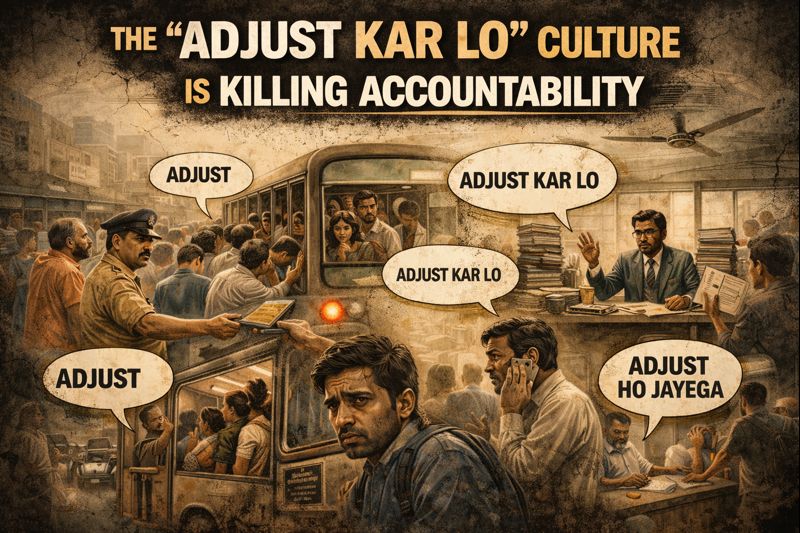
India’s real national slogan isn’t “Digital India.”
It’s “Adjust Kar Lo.”
Bad service? Adjust.
Low salary? Adjust.
Broken systems? Adjust.
Adjustment isn’t strength.
It’s resignation.
We’ve normalized struggle so much that we now romanticize suffering —
something you’ve already exposed here:
India Romanticizes Suffering
When pain becomes culture, change becomes optional.
Complaints Without Belief
Indians complain everywhere:
- Social media
- Tea stalls
- Offices
- Family dinners
But deep down, most people don’t believe real change will happen.
So they:
- Vent
- Adapt
- Move on
Hope is temporary.
Survival is permanent.
The Psychological Cost of Survival Mode
Living in survival mode creates:
- Low expectations
- Emotional burnout
- No accountability
- System stagnation
When people stop demanding better, systems stop improving.
That’s how broken structures survive for decades.
Even global studies like
Pew Research’s trust surveys
show declining confidence in institutions — and India isn’t an exception.
Why Indians Don’t Trust the System (The Real Reasons)
Not because Indians are negative.
Not because they’re lazy.
But because experience taught them not to.
The system:
- Doesn’t protect
- Doesn’t simplify
- Doesn’t listen
- Doesn’t care
So people stop believing.
They just survive.
Final Truth
Indians don’t trust the system.
They manage it.
They tolerate it.
They survive it.
Because in India, trust is a luxury —
and survival is mandatory.
FAQs
Why do Indians don’t trust the system anymore?
Because most systems feel slow, confusing, and unaccountable.
What is “adjust kar lo” culture?
It’s the mindset of accepting bad systems instead of fixing them.
Is jugaad helping or hurting India?
It helps people survive, but it hurts long-term system improvement.
Why don’t people demand better systems?
They’re trained to adapt, not challenge.
Can trust in Indian systems be rebuilt?
Only if accountability replaces adjustment culture.
1 thought on “Indians Don’t Trust the System — They Just Learn to Survive It”