
Wars feel distant until they show up in your petrol bill.
Most Indians are not tracking battle maps daily. But we all notice when fuel prices rise, when gold becomes expensive, when the rupee weakens, or when markets turn volatile. That is how global conflicts quietly enter domestic life.
If you really want to understand how global wars affect India, you need to look beyond headlines and focus on economics.
India is not fighting these wars. But India is deeply connected to the global system that reacts to them.
Let’s break this down properly.
Why Global Wars Matter for India
India imports more than 80 percent of its crude oil requirements, according to data from the Ministry of Petroleum and Natural Gas. That single number explains why instability in oil-producing regions matters so much.
Global oil markets are highly sensitive to geopolitical shocks, as outlined by the International Energy Agency. Even the risk of disruption can push prices higher.
Then there is the US dollar. During global crises, investors move money toward perceived safe assets like US Treasury bonds. The dollar strengthens. Emerging market currencies, including the rupee, often weaken.
Add to that foreign investors pulling money from equity markets during uncertainty, and you get volatility in Indian stocks.
This is not dramatic speculation. It is how interconnected economies function.
Russia–Ukraine War: Energy and Food Shockwaves
The Russia–Ukraine conflict reshaped global energy trade.
After Western sanctions on Russia, India significantly increased imports of discounted Russian crude. This helped moderate domestic fuel inflation during periods of elevated global prices.
But this arrangement depends on geopolitical stability. If sanctions tighten or shipping channels face new restrictions, supply chains can become complicated again.
Russia and Ukraine are also major exporters of grains and fertilizers. According to the World Bank Commodity Markets Outlook, disruptions in Black Sea exports contributed to global food price volatility.
Even when India is self-sufficient in many agricultural categories, global pricing influences domestic inflation expectations.
So this war affects India through:
- Energy pricing
- Agricultural commodity markets
- Trade routes
- Financial sanctions systems
Indirect, yes. Insignificant, no.
Middle East Conflict: The Oil Nerve Center
If there is one region India cannot afford instability in, it is the Middle East.
A substantial share of India’s crude oil imports comes from Gulf countries. The Strait of Hormuz remains one of the world’s most critical oil transit chokepoints. Any escalation that threatens shipping lanes can push crude prices sharply higher.
Higher crude means:
- Pressure on petrol and diesel prices
- Rising logistics costs
- Broader inflation impact
There is also the remittance dimension. India is one of the world’s largest recipients of remittances, as shown by the World Bank Migration and Remittances Data. A significant portion comes from Indian workers in Gulf nations.
Regional instability can affect employment and income flows back to India. That influences household consumption and foreign exchange inflows.
This is why Middle East tensions matter far beyond diplomacy.
The United States Factor: Dollar and Sanctions Power
You cannot analyze modern geopolitics without factoring in the United States.
The US plays a central role in:
- Sanctions enforcement
- Global financial settlement systems
- Military alliances
- Dollar liquidity
When the US tightens sanctions or increases military involvement, global markets react quickly.
During crises, the dollar strengthens. A stronger dollar often puts pressure on emerging market currencies, including the rupee. RBI intervention data and forex reserve positions are available through the RBI Statistical Releases, but no central bank can permanently override global capital flows.
US interest rate policy also matters. Higher US rates combined with geopolitical risk can accelerate foreign portfolio outflows. Foreign investment data is regularly tracked by the National Securities Depository Limited.
So even if India is not directly involved in conflicts, US policy decisions influence capital movement, currency dynamics, and investor sentiment.
Sector-Wise Impact on India
Let’s connect everything clearly.
Oil and Fuel Prices
Oil is the fastest transmission channel.
If crude prices rise:
- Fuel costs increase
- Transport becomes expensive
- Food prices move up
- Inflation broadens
India does maintain strategic petroleum reserves, but these are buffers, not permanent shields.
Higher oil imports widen the current account deficit and increase fiscal pressure if the government absorbs part of the cost through tax adjustments.
Gold Prices
Gold traditionally rises during uncertainty. Investors globally treat it as a hedge.
The World Gold Council tracks global gold demand trends, and conflict periods typically see higher investment demand.
India imports most of its gold. Higher prices mean:
- Increased import bills
- Pressure on the current account deficit
- More expensive jewellery purchases domestically
Gold is emotional in India, but economically it is also a macro variable.
Rupee and Currency Pressure
During global instability:
- Dollar strengthens
- Capital flows shift
- Rupee faces depreciation pressure
A weaker rupee makes imports more expensive. That can worsen inflation and widen trade imbalances.
RBI can intervene, but it operates within global market realities.
Stock Markets
Geopolitical uncertainty increases volatility.
Foreign investors may reduce exposure to risk assets. Defensive sectors sometimes outperform, while energy-sensitive sectors can face margin pressure.
Markets do not panic randomly. They price uncertainty.
Inflation and Interest Rates
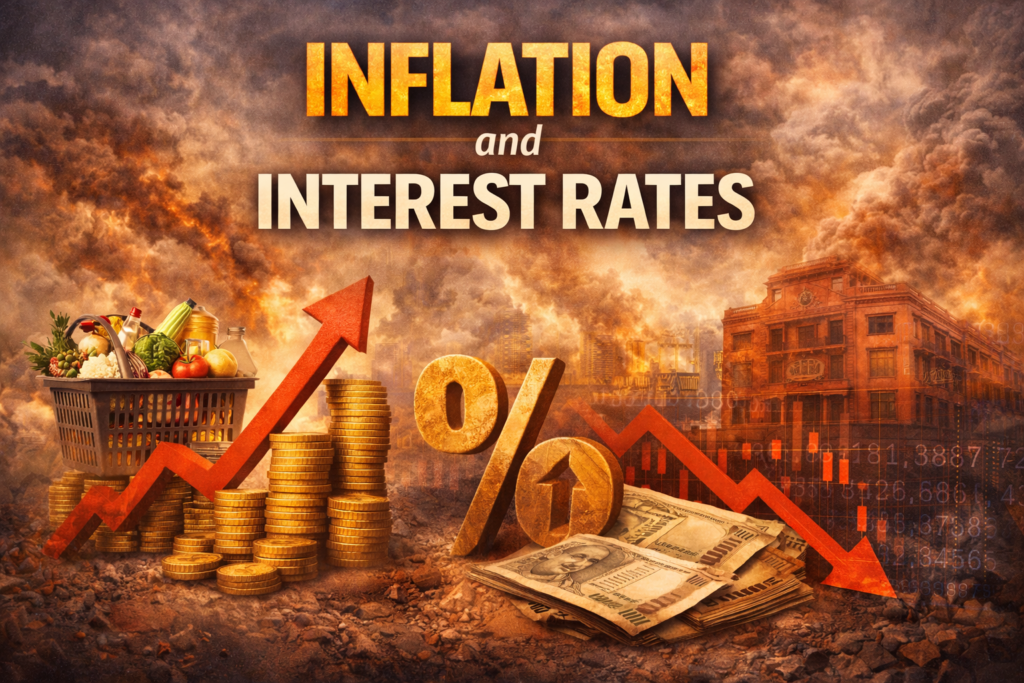
Oil-driven inflation complicates monetary policy.
If inflation rises beyond target comfort, the Reserve Bank of India may delay rate cuts or maintain tighter liquidity conditions.
That affects:
- EMIs
- Business borrowing
- Consumer spending
A war far away can influence your loan cost indirectly.
What India Is Doing
India has adopted what policymakers call strategic autonomy.
It has:
- Maintained energy trade with Russia
- Strengthened partnerships with the US and Quad nations
- Sustained defense and technology ties with Israel
- Preserved energy relationships with Gulf countries
India is not choosing sides emotionally. It is managing interests.
There has also been greater emphasis on:
- Expanding renewable energy capacity
- Increasing domestic manufacturing
- Strengthening oil reserves
These steps do not eliminate risk. They reduce vulnerability.
What Should India Do Next
If global instability continues, India’s long-term resilience depends on:
- Diversifying energy imports
- Accelerating renewable energy adoption
- Reducing excessive gold import dependence
- Expanding trade settlement flexibility
- Strengthening supply chain resilience
Economic insulation does not happen overnight. It requires sustained structural reform.
What It Means for Ordinary Indians
If global wars intensify:
- Fuel prices may rise
- Grocery bills may increase
- Gold becomes more expensive
- Markets turn volatile
- Rupee may weaken
- Rate cuts may slow
If tensions ease:
- Oil stabilizes
- Inflation moderates
- Investor confidence improves
It is not complicated. It is interconnected.
The Bigger Picture
Understanding how global wars affect India is not about alarmism. It is about realism.
Global conflicts reshape energy markets, commodity prices, capital flows, and currencies. India, as a major economy integrated into global trade, feels those shifts.
The real question is not whether wars affect India. They do.
The real question is how prepared India is to absorb the shocks.
Geopolitics may begin on battlefields. But for India, its impact shows up in budgets, markets, and policy decisions.
And that makes it everyone’s business.
FAQs
How do global wars affect India’s economy?
Global wars affect India mainly through oil prices, gold imports, currency pressure, stock market volatility, and inflation. Since India imports most of its crude oil, geopolitical instability directly impacts fuel and transport costs.
Why do oil prices rise during war?
Wars create supply uncertainty, especially in oil-producing regions. Traders price in risk, which pushes crude prices higher even before actual supply disruptions occur.
Does war increase gold prices in India?
Yes. During global uncertainty, investors buy gold as a safe asset. Higher global gold prices increase India’s import bill and raise domestic gold rates.
How does war impact the Indian rupee?
Global instability strengthens the US dollar. When investors move money into dollar assets, emerging market currencies like the rupee often weaken.
Can global wars impact Indian stock markets?
Yes. Foreign investors may reduce exposure during geopolitical uncertainty, leading to increased volatility in Indian equity markets.
What is India’s role in ongoing global conflicts?
India follows a policy of strategic autonomy. It maintains diplomatic and trade relationships with multiple global powers while prioritizing economic and energy security.
4 thoughts on “How Ongoing Global Wars Could Impact India’s Oil, Gold, Rupee and Economy — A Complete Breakdown”