
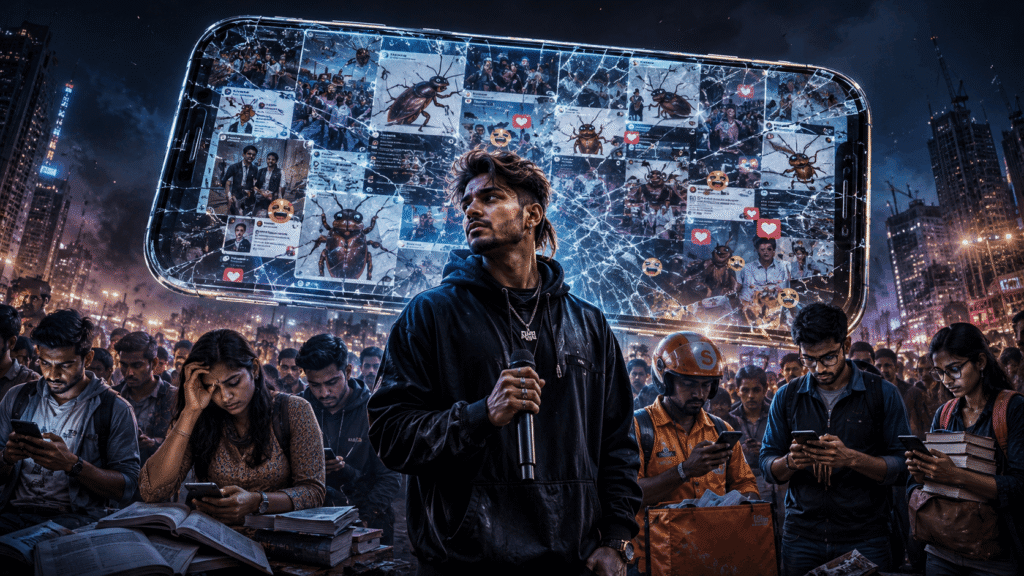
Your Insta feed this week has been one thing: cockroach memes, CJP reels, and a rapper from Ratlam telling everyone to calm down.
The Santy Sharma Cockroach Janta Party debate has taken over Indian social media in the last 72 hours. Rapper Santy Sharma called the entire Cockroach Janta Party movement “internet drama” on Instagram. Half the internet agreed with him. The other half said: bhai, sit a NEET exam twice, score well, then watch your paper get cancelled over WhatsApp, and then talk to us about drama.
Both sides have a point. That tension is exactly what this piece unpacks
Who Is Santy Sharma and What Did He Say About CJP?
Santy Sharma is a Ratlam-based independent rapper known for calling out viral trends before they go stale. He has built a real following by saying uncomfortable things most creators are too careful to touch.
On the Cockroach Janta Party, his take was blunt and direct. He called it “internet drama” on Instagram, warned young Indians not to follow viral campaigns without researching the people running them, and alleged the CJP founder had political links with the Aam Aadmi Party. He also raised concerns about foreign engagement on CJP pages and said Indian youth need to recognise digital manipulation dressed as activism.
He said India needs “development, innovation, employment, and constructive discussions” and not social media chaos.
His post spread fast. Thousands agreed. Thousands more pushed back hard. The Santy Sharma CJP debate became the next loud layer on top of an already messy national conversation that was never just about memes.
What Is the Cockroach Janta Party and Why Did 22 Million Indians Show Up?
On May 15, 2026, Chief Justice of India Surya Kant made remarks during a Supreme Court hearing that were widely reported as comparing unemployed young Indians to “cockroaches” and calling them “parasites of society.” He later clarified he was targeting people entering professions with fake degrees, not India’s youth in general.
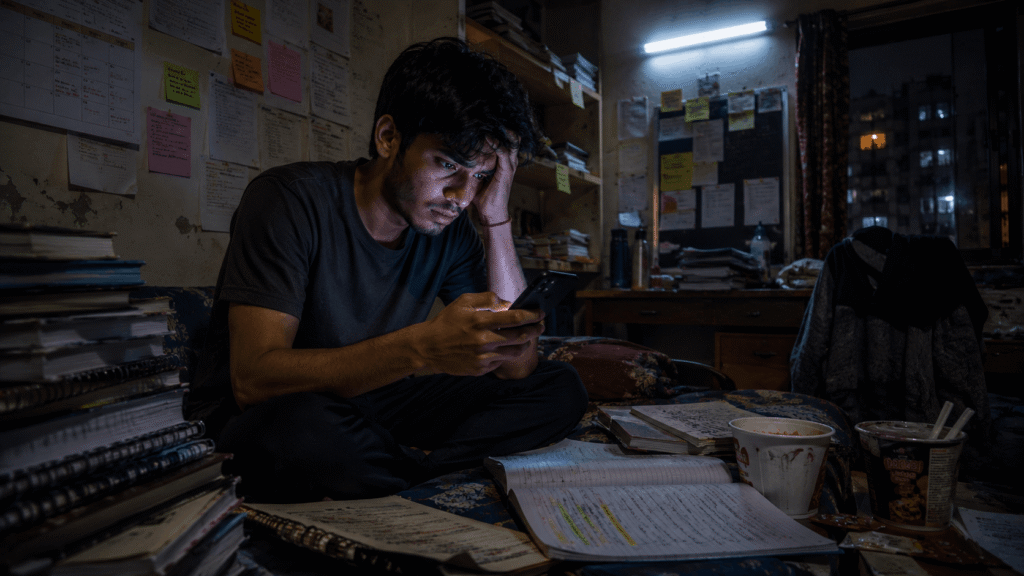
The clarification came too late. Those words had already landed on 22-year-olds in PG rooms in Pune, coaching centres in Kota, and rented rooms in Bengaluru who were already exhausted and already invisible to the system.
Abhijeet Dipke, a 30-year-old from Aurangabad studying public relations at Boston University, launched the Cockroach Janta Party within 24 hours of that remark. Full website, manifesto, logo, and Instagram account, built entirely on AI tools and zero rupees.
Within days, CJP crossed 22 million Instagram followers, beating both BJP and Congress on the platform. Over 6 lakh people signed up on Google Form. The eligibility criteria read: “Unemployed, lazy, chronically online, ability to rant professionally.”
This is the India youth unemployment protest of 2026. It started with one WhatsApp-leaked exam and one courtroom remark.
Is Cockroach Janta Party Real or Just Internet Drama?
This is the core question sitting at the heart of the Santy Sharma Cockroach Janta Party debate. The honest answer: it is both, and that is not a contradiction.
The Part Santy Got Right
The CJP India Gen Z movement got messy fast. TMC MPs Mahua Moitra and Kirti Azad publicly joined within a week. Congress, Shiv Sena UBT, and Samajwadi Party all rallied behind it. Viral analytics claimed a large portion of CJP followers came from outside India, including Pakistan and Bangladesh. Dipke denied it, but the claim dented credibility with undecided young Indians.
Santy’s concern about blind digital activism is fair. A generation raised on 30-second reels is genuinely vulnerable to movements that look like collective rage but function like political machinery. The AAP link controversy, the Pakistan followers angle, and the X account block all hit CJP in the same week. The full CJP controversy breakdown covers exactly how the movement shifted from a youth mirror to an opposition tool so quickly.
The Part Santy Got Wrong
Calling it “internet drama” erases the one thing that made this movement real: the wound existed before the meme did.
According to the State of Working India 2026 report by Azim Premji University, nearly 40% of Indian graduates between 15 and 25 are currently unemployed. Two-thirds of all unemployed Indians aged 20 to 29 already hold degrees. Every year roughly 5 million graduates enter the workforce, but only 2.8 million find employment. Less than 7% of male graduates land a permanent salaried job within a year of finishing their degree.
The more you study in India, the harder it becomes to find work.
Then add this. NEET UG 2026 was cancelled on May 12 after a coordinated paper leak, hitting over 22 lakh aspirants. A 23-year-old from Sikar, Rajasthan, whose family had sold land to fund his coaching, died by suicide after the cancellation. NTA opened a refund portal. No refund covers two years of preparation and a family’s savings.
This is not content. This is a real family’s future cancelled over a WhatsApp forward.
Why India’s Gen Z Chose Memes Over Marches
Here is what the older political commentary class keeps getting wrong about the Cockroach Janta Party movement: the memes are not the problem. The memes are the medium.
Gen Z watched RTI activists get ignored, anti-corruption marches die in press conferences, and BYJU’s collapse wipe out families paying Rs 40,000 to Rs 80,000 EMIs on tablets that stopped working. They saw NEET leak in 2024, heard the denial, then watched it leak again in 2026.
Silence was tried. Marches were tried. So they built a cockroach party.
The CJP manifesto was not a joke. Five specific institutional demands: no post-retirement Rajya Sabha seats for Chief Justices, 50% women’s reservation in Parliament and Cabinet, cancellation of Adani and Reliance media licences, a 20-year election ban for defecting politicians, and stronger voter protections.
These are not meme demands. These are conversations already happening in college WhatsApp groups and Telegram channels from Lucknow to Chennai every single day. CJP gave them a logo, a Google Form, and a cockroach emoji.
The Real Problem Nobody Is Saying Out Loud
Here is the part both Santy’s supporters and his critics keep missing.
Both the anger and the manipulation can be true at the same time.
CJP started as a mirror held up to institutional failure. Then the opposition arrived. Then the AAP controversy exploded. Then the counter-parties launched one by one: Oggy Janta Party, Lullaby Party, Billi Janta Party. The five real manifesto demands drowned under anti-BJP reels and Bollywood celebrity follows within a week.
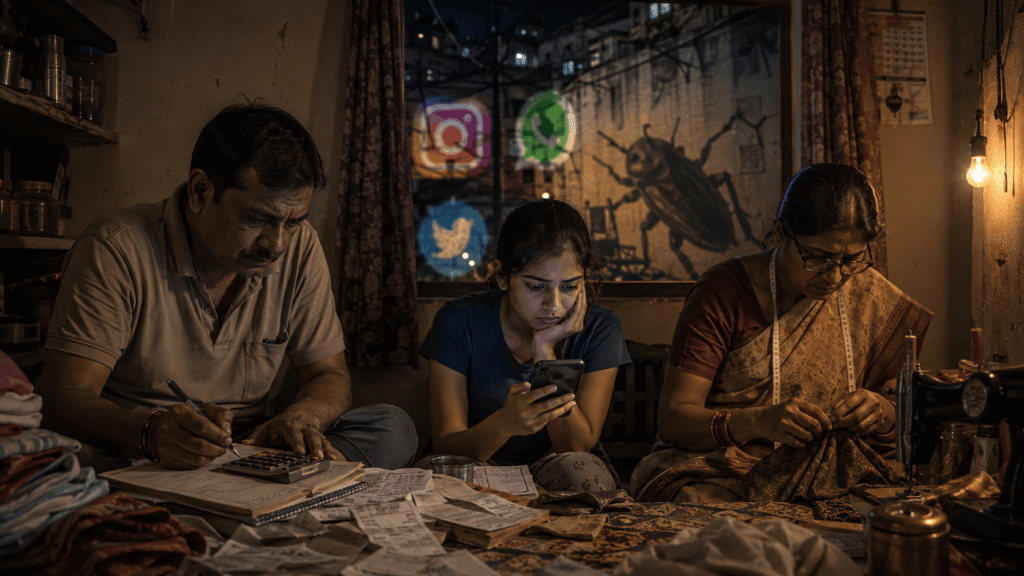
Middle India got used again. The lower middle class family in Nagpur where the father runs a kirana store, the mother stitches garments from home, and their daughter just found out her NEET result is invalid. They are not trending on anyone’s Instagram. They are figuring out how to cover this month’s EMI.
The Nagpur kirana family is not waiting for the next viral wave. The Sikar boy’s father is not checking CJP’s Instagram follower count.
To understand why 22 million people showed up in the first place, you have to go back further than the CJP launch itself. You need to understand what the Chief Justice’s remark revealed about how India’s system actually sees its own youth and why that hit differently than anything said at a political rally.
Santy is right that Gen Z needs to think carefully about who profits from their outrage. He is wrong to stop at “drama,” as if the underlying anger is not a legitimate response to a legitimate failure.
“Be constructive” only works when the system is also being constructive in return.
Santy Sharma Cockroach Janta Party Debate

The Santy Sharma Cockroach Janta Party conversation matters because both sides are touching something real at the same time.
Santy is right that viral movements get captured and turned into political tools fast. CJP proved it within one week.
But a generation that has absorbed three years of exam leaks, watched BYJU’s collapse erase family savings, been called parasites by the Chief Justice of India, and sent 200 applications on Naukri.com without a single callback does not owe power a polished, algorithm-friendly protest.
When every formal door is locked, the drama is not the problem. The locked doors are.
The 22 lakh NEET aspirants, the Swiggy rider with a BCom degree, the girl in a tier-3 UP town who fought her entire family for the right to study. All still exactly where they were before the cockroach emoji went viral.
They are not waiting for someone to go viral about it. They are waiting for someone to stay focused long after the meme cycle ends.
FAQs
What did Santy Sharma say about Cockroach Janta Party?
Santy Sharma described the Cockroach Janta Party trend as “internet drama” and warned young Indians against blindly following viral online movements without understanding who is behind them.
Is Cockroach Janta Party a real political movement?
Cockroach Janta Party started as internet satire, but many young Indians now see it as a symbol of frustration related to unemployment, exam leaks, and distrust in institutions.
Why is Cockroach Janta Party trending in India?
The trend exploded after controversial remarks linked to unemployed youth went viral online. Meme culture, Gen Z frustration, and social media activism pushed the movement into mainstream discussion.
Why are Gen Z users supporting CJP?
Many Gen Z users relate to the movement because it reflects concerns about jobs, rising costs, exam scandals, and the pressure of modern Indian life.
Is Santy Sharma being criticized online?
Yes. While some people agreed with Santy Sharma’s criticism of digital activism, others argued he ignored the deeper frustrations driving the movement.