
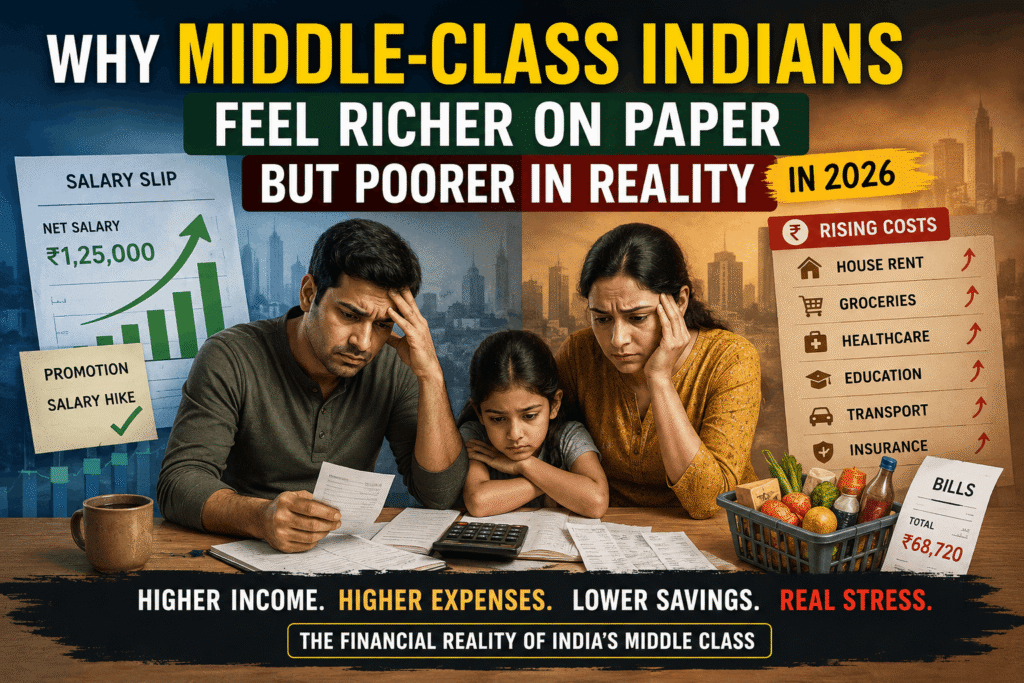
For many middle-class families in India, earning more money no longer brings the sense of financial security it once did.
Salary slips have grown over the years, promotions have become more common, and household incomes have generally increased. Yet many families still reach the end of the month wondering why there is so little left to save.
That contradiction has become one of the biggest financial conversations in India today.
Many middle-class Indians say they feel wealthier on paper but financially stretched in everyday life.
According to the latest Consumer Price Index (CPI) data released by the Ministry of Statistics, India’s retail inflation rose to 3.93% in May 2026, up from 3.48% in April.
The same official release reported food inflation at 4.78%, while urban retail inflation stood at 3.53% and rural inflation reached 4.25%. Although headline inflation has moderated compared with earlier highs, many essential expenses continue to put pressure on household budgets.
That growing gap between income and purchasing power has become one of the defining financial challenges facing the middle class in India.
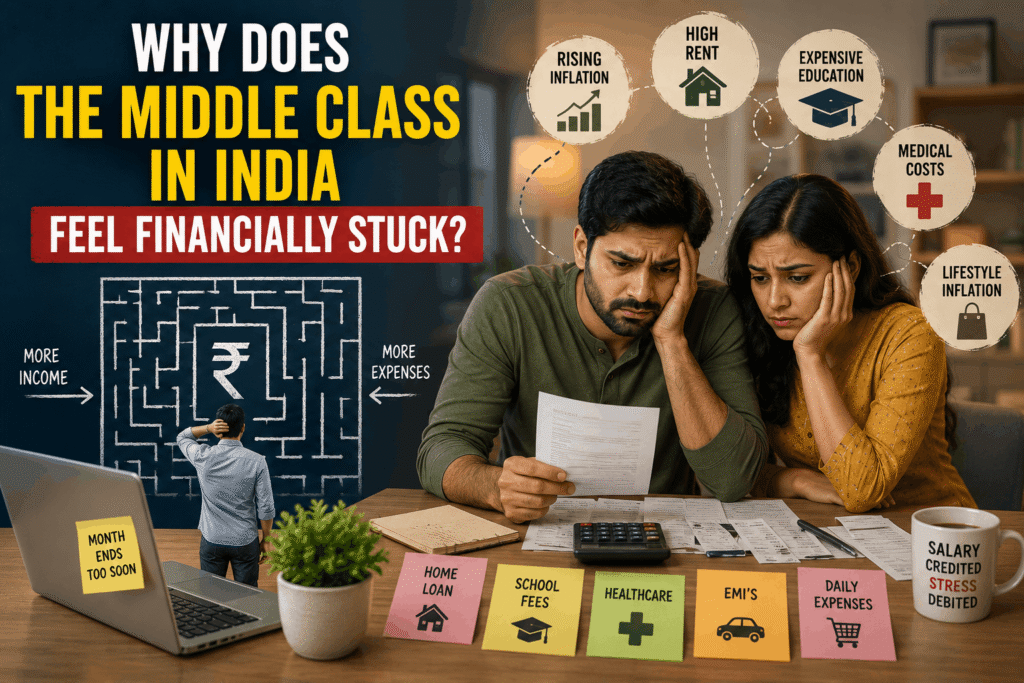
Why Does The Middle Class In India Feel Financially Stuck?
The answer is not simply that prices have increased.
The real issue is that incomes and expenses are moving in different directions.
Salary hikes are always welcome, but for many households they are quickly absorbed by higher housing costs, education expenses, healthcare bills, insurance premiums, transportation costs, and other recurring commitments.
As a result, every salary increase feels smaller than expected.
These financial pressures affect households across a wide range of professions and income groups, not just young professionals beginning their careers.
Families living in Bengaluru, Hyderabad, Mumbai, Pune, Delhi NCR, and many other cities are experiencing similar challenges despite earning more than they did just a few years ago.
If you’ve already read our guide on why young professionals in India are earning better salaries but still struggling financially, you’ll notice that many of those same financial pressures now affect middle-class households across every stage of life.
Has The Middle Class Lifestyle In India Become More Expensive?
For most families, the answer is yes.
The middle class lifestyle in India has changed significantly over the past decade.
Expenses that were once considered optional have gradually become part of everyday life.
High-speed internet, smartphones, online education, health insurance, streaming services, and app-based deliveries have become regular monthly expenses for millions of households.
While these services improve convenience, they also increase recurring costs.
Recent reporting from The Hindu’s Business and Economy section continues to highlight how inflation, consumer spending, and food prices remain important concerns for Indian families.
The situation is especially noticeable in cities such as Bengaluru, Hyderabad, Mumbai, Pune, Chennai, and Gurugram, where higher salaries are often offset by significantly higher living costs.
Is Inflation In India The Only Problem?
Not entirely.
Inflation in India certainly affects purchasing power, but it is only one part of the picture.
Housing continues to be one of the largest monthly expenses for many urban middle-class families. Rising rents and home loan EMIs leave many households with less disposable income for savings and investments.
Healthcare costs remain a significant financial burden, particularly when insurance premiums and out-of-pocket medical expenses are added together.
Education expenses have also increased steadily, making it harder for families to balance current needs with future financial goals.
These challenges are closely linked to the broader cost of living in India. Rising housing costs, groceries, healthcare, transportation, and education have made many households feel wealthier on paper while experiencing greater financial pressure in everyday life.
Recent analysis from Moneycontrol’s personal finance coverage also highlights rising household expenses and budgeting challenges as major concerns for Indian consumers.
Why Doesn’t A Higher Income Always Feel Like Progress?
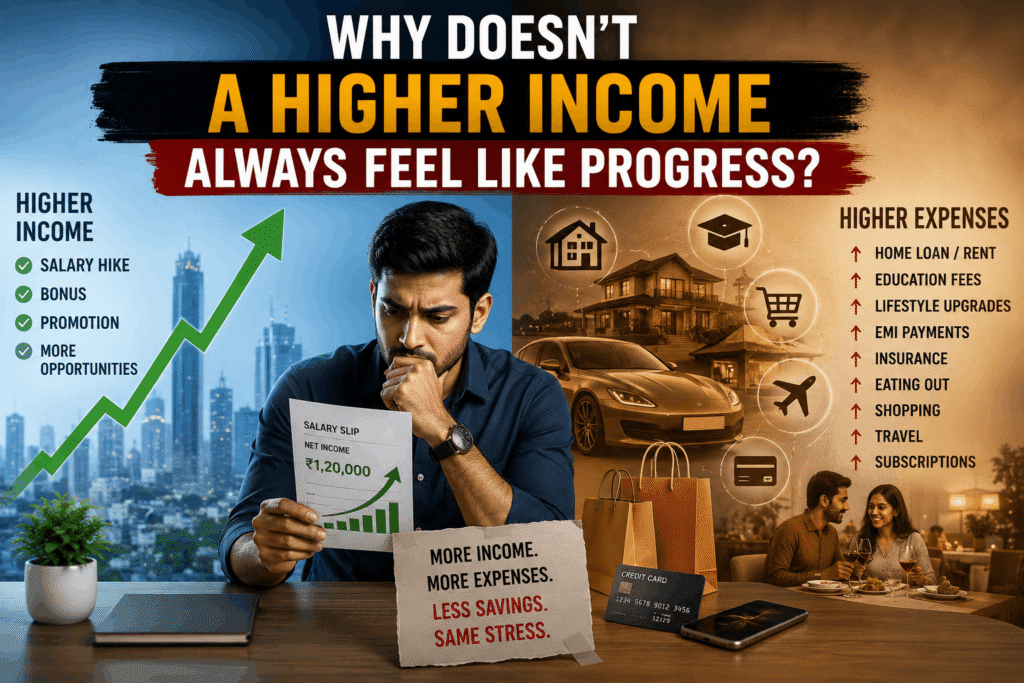
Another important reason is lifestyle inflation.
As income grows, spending often grows alongside it.
Families move into larger homes, purchase newer cars, upgrade smartphones, travel more frequently, or subscribe to additional digital services.
None of these choices are necessarily wrong.
The challenge begins when every salary increase immediately becomes another monthly expense.
Apps like PhonePe, Google Pay, and Paytm have also made spending almost effortless. Small digital payments may seem insignificant on their own, but together they can quietly reduce monthly savings.
Can Middle-Class Families Still Build Wealth In 2026?
Absolutely.
The financial journey has become more challenging, but it is far from impossible.
Many experts agree that building wealth today depends as much on disciplined financial habits as it does on earning a higher income.
Salary growth alone rarely guarantees long-term financial security.
Why Is Financial Planning More Important Than Ever?
For today’s middle class in India, financial planning has become essential.
A typical household may be managing rent or home loan EMIs, school fees, health insurance, vehicle loans, emergency savings, retirement planning, and support for ageing parents at the same time.
Without a clear financial plan, even a healthy income can disappear quickly.
According to the Reserve Bank of India’s latest monetary policy updates, maintaining price stability remains one of the central bank’s key priorities for supporting sustainable economic growth.
However, national inflation figures do not always reflect an individual household’s financial experience. Housing costs, family responsibilities, and personal spending habits often have a much greater influence on monthly budgets.
That is why financial planning has become one of the most valuable skills for Indian families.
Recent reporting by The Economic Times on India’s economy and household finances also points to changing spending patterns, rising household costs, and long-term financial planning as growing priorities for middle-class families.
What Can Middle-Class Indians Do To Reduce Financial Pressure?
While there is no quick solution, a few consistent habits can make a meaningful difference.
Consider these practical steps:
- Track every monthly expense instead of estimating where money goes.
- Increase SIP or retirement investments whenever your income increases.
- Build an emergency fund that can cover at least six months of essential expenses.
- Avoid unnecessary EMIs for purchases that quickly lose value.
- Review subscriptions and recurring digital payments regularly.
- Compare insurance policies from time to time to ensure adequate coverage at a competitive price.
- Focus on long-term financial goals instead of short-term lifestyle upgrades.
Small improvements repeated consistently often produce far better results than waiting for one large salary increase.
Is Feeling Poorer Really About Money?
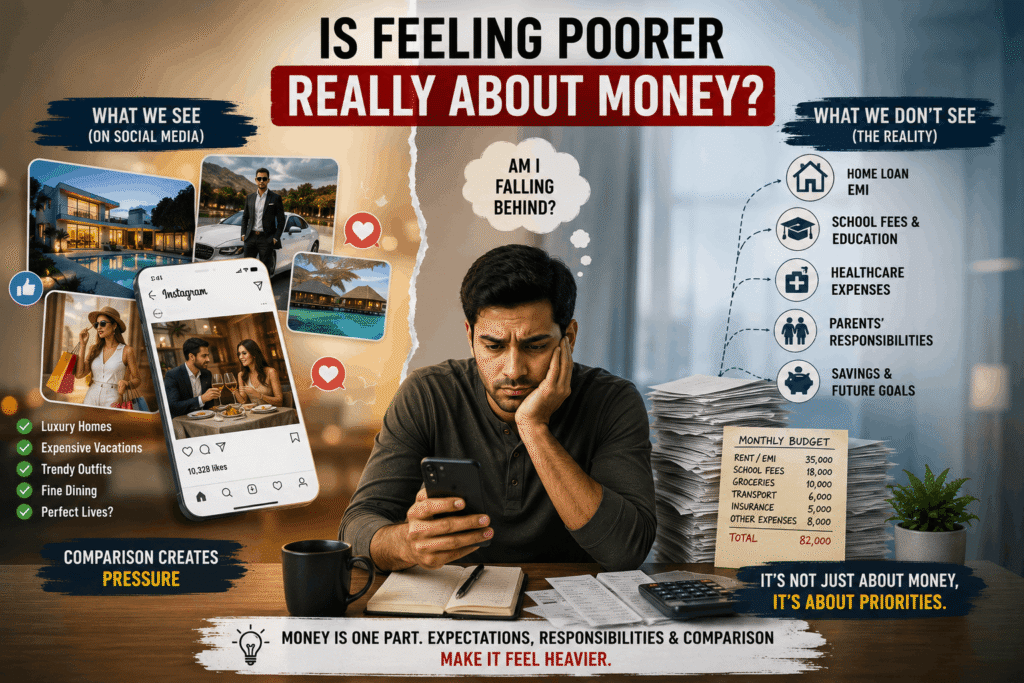
Money is only one part of the story.
Expectations also play a major role.
Social media constantly exposes people to luxury homes, premium cars, expensive holidays, and lifestyles that appear effortless.
Comparing everyday life with carefully curated online content can make even financially stable households feel as though they are falling behind.
Many middle-class families are also trying to achieve several major goals at once, including buying a home, funding quality education, supporting ageing parents, saving for retirement, and building investments.
Managing all these responsibilities simultaneously naturally creates financial pressure, even for households with stable incomes.
The Bottom Line
The middle class in India is earning more than it did a decade ago.
Yet many families also feel financially weaker.
The reason is not simply inflation in India.
It is the combined effect of rising housing costs, healthcare expenses, education costs, insurance premiums, transportation, and lifestyle inflation that has changed the financial reality of millions of households.
These same pressures are also increasing the cost of living in India, making it increasingly difficult for families to convert higher incomes into lasting financial security.
The experiences of many households also mirror those of young professionals in India who are earning better salaries but still struggling financially. What once appeared to be a challenge mainly for younger workers has increasingly become a broader middle-class reality.
A higher salary is still valuable.
However, lasting financial progress depends on more than income alone. It depends on how much money remains after paying for housing, healthcare, education, transportation, insurance, and other everyday essentials.
For millions of families, the biggest challenge is no longer finding a better-paying job. It is making sure that every salary hike genuinely improves their quality of life instead of disappearing into higher living costs.
Until income grows faster than everyday expenses, many middle-class Indians are likely to continue feeling richer on paper but poorer in reality.
FAQs
Why do middle-class Indians feel richer on paper but poorer in reality?
Many middle-class Indians have seen their incomes rise over time, but essential expenses such as housing, groceries, healthcare, education, and insurance have also increased. As a result, many households feel financially stretched despite earning more.
Is inflation the biggest reason middle-class families are struggling?
Inflation is one factor, but it is not the only one. Rising housing costs, education expenses, healthcare, transportation, and lifestyle inflation all contribute to financial pressure.
Why doesn’t a salary hike improve financial security?
Salary increases are often absorbed by higher living costs and recurring expenses. Without disciplined budgeting and investing, higher income may not translate into greater savings.
What is lifestyle inflation?
Lifestyle inflation happens when spending increases as income grows. Upgrading homes, vehicles, gadgets, or subscriptions can reduce the financial benefits of salary growth.
How can middle-class families improve their financial situation?
Creating a monthly budget, building an emergency fund, investing consistently through SIPs, reducing unnecessary debt, and reviewing recurring expenses can help improve long-term financial stability.
Is the cost of living increasing for the middle class in India?
Yes. Many households have experienced higher expenses for housing, groceries, healthcare, education, transportation, and insurance, making everyday life more expensive.
1 thought on “Why Middle-Class Indians Feel Richer On Paper But Poorer In Reality In 2026”