
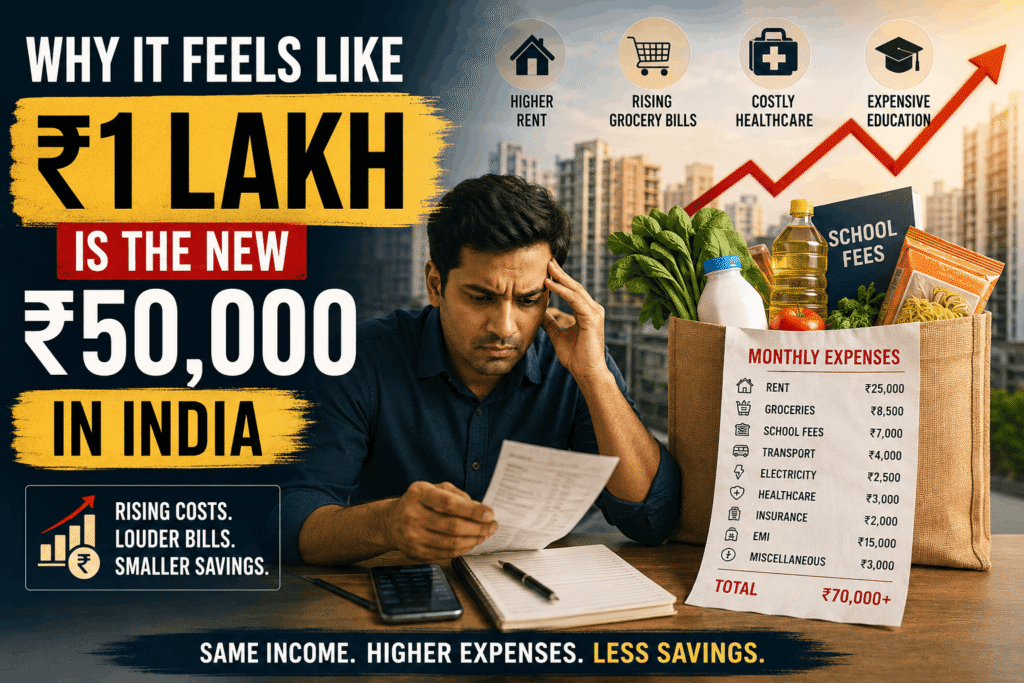
Have you ever looked at your salary credit message and wondered where all the money went before the month even ended?
You are not alone.
Across cities and towns in India, many people earning what was once considered a comfortable income now feel financially stretched. Whether it is rent, groceries, school fees, healthcare, or everyday bills, expenses seem to be rising faster than peace of mind.
That is why a growing number of Indians feel that ₹1 lakh is the new ₹50,000.
No, this is not an official economic calculation. It is a reflection of how the cost of living in India has changed and how much less purchasing power many families feel they have today.
Why Does ₹1 Lakh Not Feel Like A Big Salary Anymore?
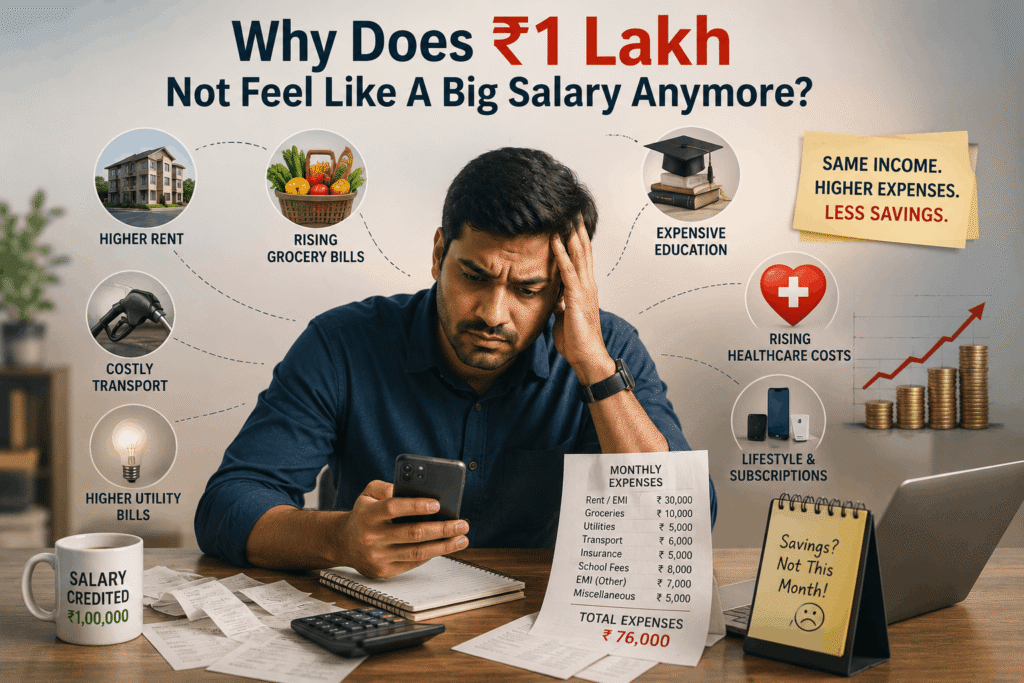
For many Indians, earning ₹1 lakh per month was once viewed as a major financial milestone associated with stability and comfort.
Today, that same income often feels very different.
A large portion of a household’s earnings now disappears into essential expenses before any meaningful savings can happen. Housing, education, healthcare, transportation, insurance, and daily necessities consume a growing share of monthly budgets.
The result is simple.
People may be earning more than they did a few years ago, but they do not necessarily feel richer.
That gap between income growth and financial comfort is at the heart of why this conversation is becoming so common across the country.
Has The Cost Of Living In India Increased That Much?
The short answer is yes.
The cost of living in India has risen steadily across many of the categories that matter most to middle-class families.
According to the latest Consumer Price Index (CPI) data released by the Ministry of Statistics, India’s retail inflation rose to 3.93% in May 2026, up from 3.48% in April.
Food prices remain a major concern for households. Official data shows that food inflation reached 4.78%, highlighting the pressure many families continue to face while managing monthly budgets.
Numbers on a government report are one thing.
What people experience at home is another.
When grocery bills, electricity charges, transportation costs, and service expenses all rise together, even moderate inflation can feel much larger in everyday life.
This is one reason why many families feel their salary is not stretching as far as it used to.
Why Is The Middle Class In India Feeling More Pressure?
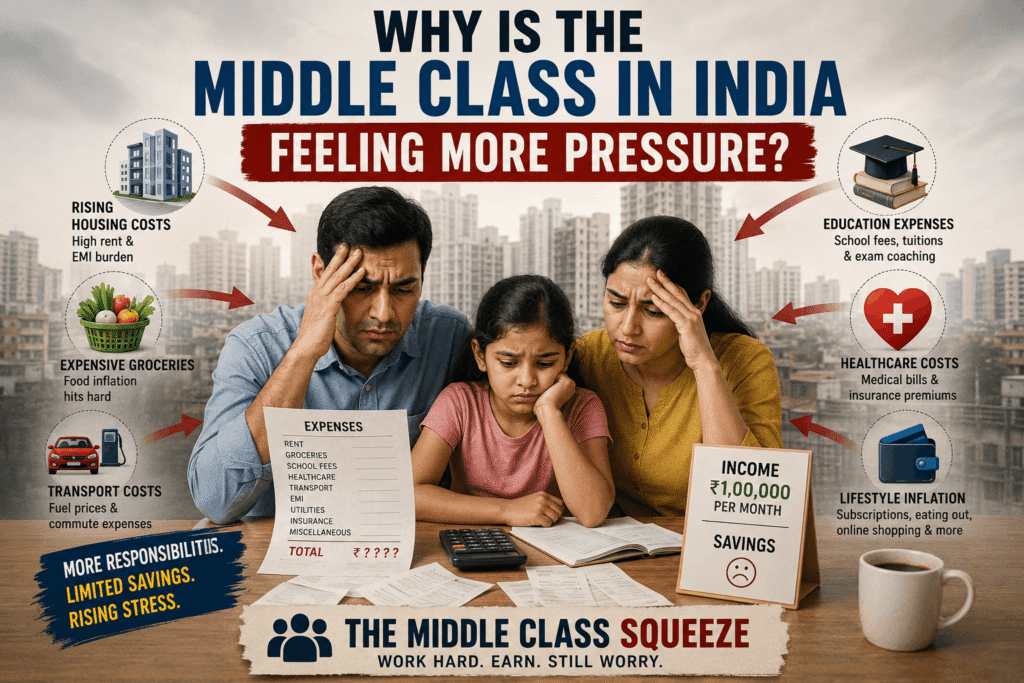
The middle class in India occupies a difficult position.
Most families earn too much to qualify for government support schemes, but often not enough to comfortably absorb rising expenses year after year.
This has created what many economists describe as a middle-class squeeze.
Housing Is Taking A Bigger Bite Out Of Salaries
Housing remains one of the biggest expenses for Indian households.
In cities like Bengaluru, Mumbai, Hyderabad, Pune, and Gurugram, both rents and home loan EMIs consume a significant portion of monthly income.
Recent coverage from Moneycontrol’s real estate section continues to highlight strong housing demand in major employment hubs.
For many young professionals, housing costs alone can determine whether they are able to save, invest, or simply get through the month comfortably.
Education Costs Continue To Climb
Parents across India are spending more than ever on education.
School fees, coaching classes, competitive exam preparation, and online learning tools have become major expenses for many families.
Even households with stable incomes are finding it harder to balance educational aspirations with other financial responsibilities.
Healthcare Has Become A Major Budget Item
Medical costs continue to worry middle-class families.
Health insurance premiums have increased for many households, while hospital treatments, diagnostics, and specialist consultations remain expensive.
A single medical emergency can still put significant pressure on family finances.
Is Inflation In India The Only Reason?
Not really.
Inflation in India is only one part of the story.
The other part is something many people do not notice immediately: lifestyle inflation.
As incomes rise, expectations often rise too.
Many services that were once considered luxuries have quietly become everyday necessities.
Think about how much money now goes toward:
- High-speed internet
- OTT subscriptions
- Food delivery apps like Swiggy and Zomato
- Premium smartphones
- Online shopping
- Subscription-based services
None of these expenses seem large on their own.
Together, however, they can consume thousands of rupees every month.
The widespread use of UPI apps such as PhonePe, Paytm, and Google Pay has also made spending almost effortless. Payments happen instantly, which often makes it harder to track how much money is leaving the account.
Meanwhile, the Reserve Bank of India’s monetary policy updates continue to monitor inflation trends and consumer spending patterns across the economy.
What Does The Modern Indian Middle Class Lifestyle Look Like?
The Indian middle class lifestyle has changed dramatically over the last decade.
Previous generations often focused on a smaller set of financial goals.
Buying a home, saving for retirement, and building fixed deposits were usually the primary priorities.
Today’s households face a much longer list.
Many families are simultaneously managing:
- Home loan EMIs
- Vehicle loans
- Children’s education expenses
- Health insurance
- Emergency savings
- Investments through platforms like Zerodha
- Retirement planning
The financial balancing act has become much more complex.
This is particularly visible in fast-growing urban centres where salaries have increased, but living costs have also climbed sharply.
Take Bengaluru as an example.
A young professional may earn significantly more than someone in a smaller city, but the higher cost of housing, transportation, and daily living often reduces the advantage that income appears to provide.
Can The Situation Improve?
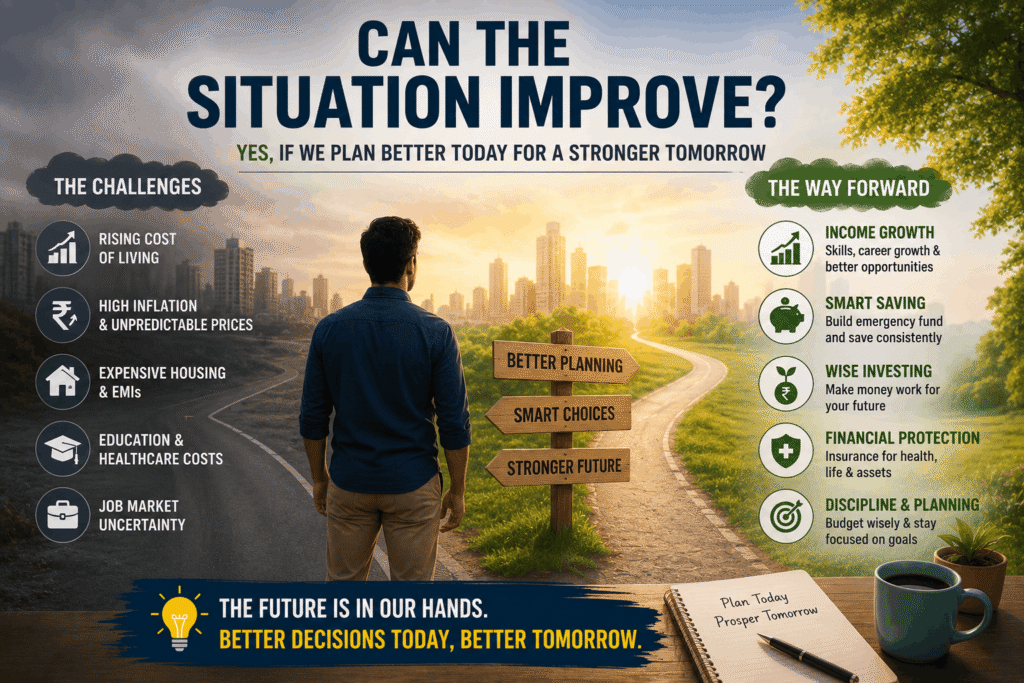
There are reasons for cautious optimism.
Recent reports suggest that easing global oil prices could help reduce some inflationary pressure if the trend continues. Economic growth also remains relatively strong compared with many major economies.
According to The Hindu’s economy coverage, policymakers continue to focus on balancing economic growth with inflation control.
However, the challenge for most households remains straightforward.
If wages grow slower than the cost of living in India, families will continue to feel financially stretched regardless of what the headline economic numbers say.
That is the reality many Indians are dealing with today.
The Bottom Line
The reason ₹1 lakh feels like the new ₹50,000 in India is not because the value of money has literally been cut in half.
It is because the cost of living in India has risen across housing, food, healthcare, education, transportation, and everyday services.
At the same time, modern lifestyles have introduced new recurring expenses that previous generations did not have to manage.
The real issue is not how much someone earns on paper.
The bigger question is how much purchasing power remains after paying for life’s essentials.
For millions of people across the middle class in India, that answer feels less comfortable today than it did just a few years ago.
And that is exactly why the phrase “₹1 lakh is the new ₹50,000” resonates with so many Indians.
FAQs
What is the current cost of living in India in 2026?
The cost of living in India varies by city and lifestyle, but rising housing, food, healthcare, and education costs have increased financial pressure on many households.
Why does ₹1 lakh not feel like a high salary anymore?
Many Indians feel that rising living expenses have reduced the purchasing power of ₹1 lakh compared to previous years, especially in major cities.
Is inflation in India responsible for higher living costs?
Inflation is one factor, but rising housing costs, education expenses, healthcare bills, and lifestyle spending also contribute significantly.
Which Indian cities have the highest cost of living?
Mumbai, Bengaluru, Delhi NCR, Hyderabad, Pune, and Chennai are among the cities where living costs can be significantly higher than the national average.
How has the middle class in India been affected by rising costs?
Many middle-class families are spending a larger share of their income on essentials, leaving less money available for savings and investments.
What expenses have increased the most in recent years?
Housing, school fees, healthcare, insurance premiums, transportation, and food costs have seen notable increases.
Can a family live comfortably on ₹1 lakh per month in India?
It depends on the city, family size, and lifestyle. In smaller cities, ₹1 lakh can provide a comfortable lifestyle, while in major metros it may feel less sufficient.
What is lifestyle inflation?
Lifestyle inflation occurs when spending increases as income rises, leading to higher monthly expenses despite earning more money.
2 thoughts on “Why It Feels Like ₹1 Lakh Is The New ₹50,000 In India: The Rising Cost Of Living Explained”