
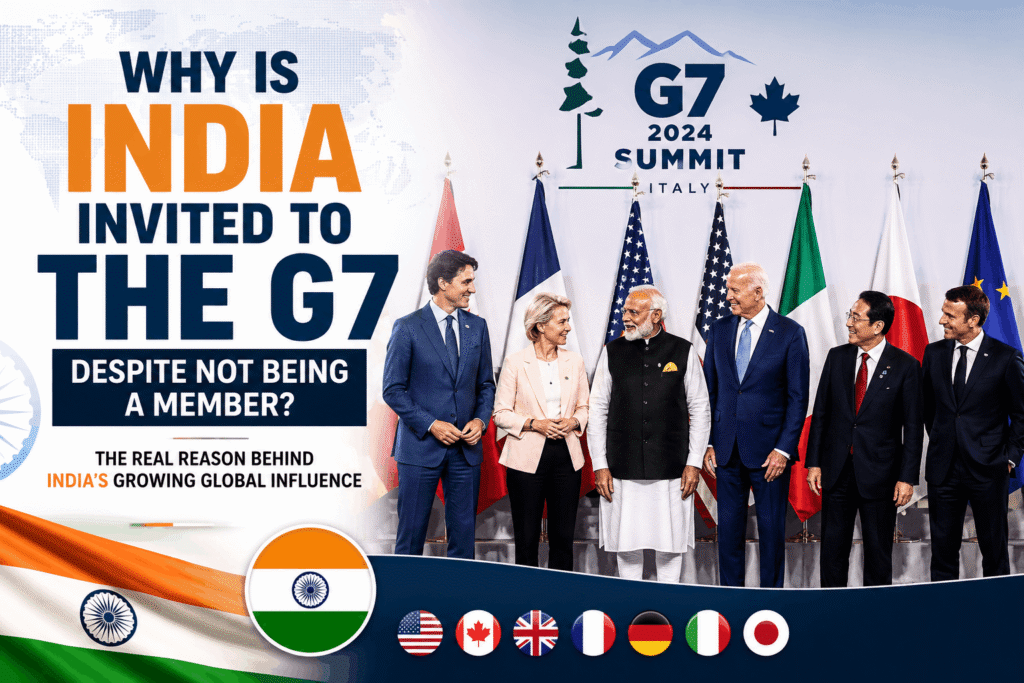
If you’ve opened Google or watched the news this week, you’ve probably seen Prime Minister Narendra Modi attending the G7 Summit alongside leaders from some of the world’s most powerful economies.
That naturally raises a question many Indians are asking right now.
If India is not a G7 member, why does it keep getting invited to the summit?
The phrase India invited to G7 has become a trending search term whenever India participates in these high-profile meetings. Many people assume only member countries can attend, which makes India’s repeated presence seem surprising.
The answer is actually quite straightforward.
India may not be a G7 member, but it has become one of the most influential countries shaping the future of the global economy.
This year’s summit has once again brought attention to India’s growing international role. According to a Hindustan Times report on PM Modi’s participation at the G7 Summit, India joined discussions involving some of the world’s leading economies despite not being part of the official G7 membership.
The invitation is also not a one-time gesture. Prime Minister Modi recently pointed out that this is the eighth consecutive G7 Summit to which India has been invited. That consistency says a lot about how the world views India’s economic and diplomatic importance today.
What Is the G7 and Is India a Member?
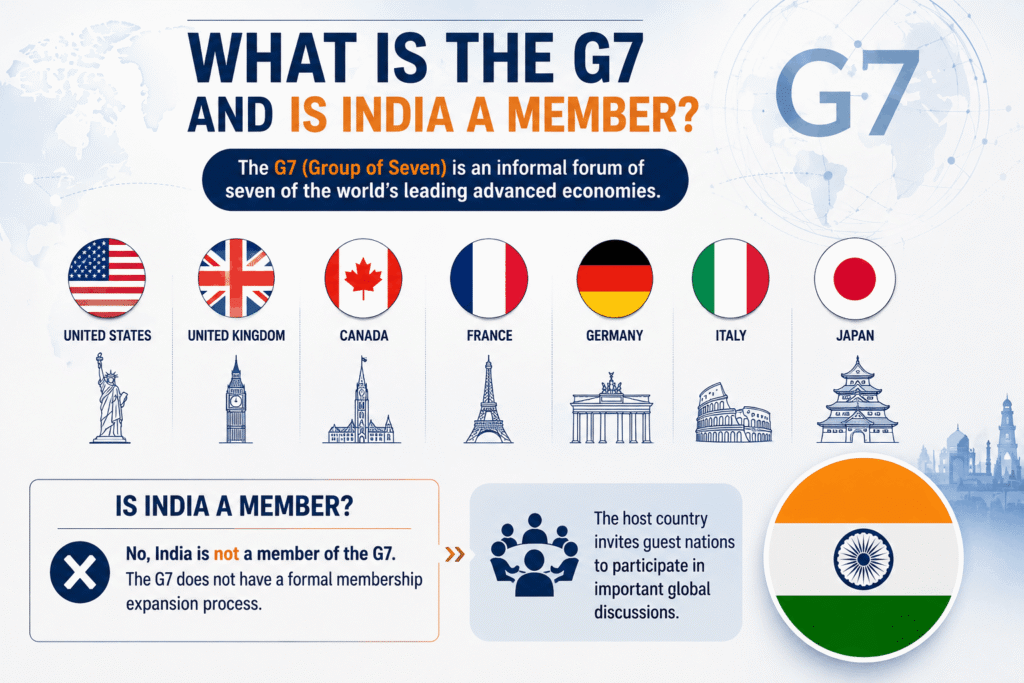
The G7, or Group of Seven, is an informal forum consisting of:
- United States
- United Kingdom
- Canada
- France
- Germany
- Italy
- Japan
The group meets every year to discuss issues such as economic growth, trade, climate policy, technology, energy security, and international stability.
However, India is not a G7 member.
Unlike organizations such as the United Nations or BRICS, the G7 does not have a formal process that allows countries to apply for membership. Instead, the host nation can invite guest countries that it believes should be part of important global discussions.
This is one reason the India invited to G7 debate returns every year. While India remains outside the formal membership structure, its growing influence makes it a regular participant in summit discussions.
Why Is India Invited to the G7 Despite Not Being a Member?
The biggest reason is simple.
India matters more to the global economy today than it did a decade ago.
The reason India invited to G7 keeps becoming a major news story is because India’s influence on trade, technology, manufacturing, energy security, and global growth has increased dramatically.
India is currently the world’s fifth-largest economy and the most populous country. Decisions made in New Delhi increasingly affect global markets, just as decisions made by other major economies affect India.
Ahead of the summit, Prime Minister Modi said India would use the platform to represent the interests and aspirations of the Global South. According to a Times of India report on India’s priorities at the G7 Summit, India plans to raise issues affecting developing countries across Asia, Africa, and Latin America.
This role has made India an important bridge between developed economies and emerging nations.
India’s Economic Rise Has Changed the Global Conversation
One of the biggest reasons behind stronger India G7 relations is India’s economic growth.
Over the past decade, India has transformed into one of the fastest-growing major economies in the world. Massive investments in infrastructure, manufacturing, digital technology, renewable energy, and innovation have strengthened the country’s global position.
Another reason the India invited to G7 story continues to gain attention is India’s economic transformation. Global leaders increasingly view India as a country that will play a major role in future economic growth.
The impact is visible in everyday life.
Millions of Indians now use UPI, PhonePe, Paytm, Swiggy, Zomato, and Zerodha. These platforms have become examples of how India is building large-scale digital systems that attract international attention.
For global policymakers, India is no longer simply a market with future potential.
India is already an important contributor to global economic growth.
India Has Become Critical to Global Supply Chains
Recent disruptions to international trade forced countries to rethink how global supply chains operate.
Many governments and businesses are now looking to diversify manufacturing and reduce dependence on a limited number of locations.
Global supply chain diversification is another major factor behind why India invited to G7 remains an important topic. Countries increasingly view India as a strategic manufacturing and technology partner.
India has made significant progress in this area.
Electronics manufacturing in Tamil Nadu, semiconductor projects in Gujarat, and expanding industrial corridors across several states have strengthened India’s position in global supply chains.
When G7 leaders discuss manufacturing resilience, advanced technology, and economic security, India’s experience and capabilities have become increasingly relevant.
India Represents More Than Just Itself
One of India’s most unique strengths is its ability to represent a much broader group of countries.
Many developing nations across Asia, Africa, and Latin America do not have a seat at the G7 table.
India often acts as a bridge between advanced economies and emerging markets.
This allows India to bring attention to issues such as food security, energy access, climate financing, sustainable development, and economic growth.
As one of the world’s largest developing economies, India offers perspectives that many G7 members cannot directly represent.
That diplomatic role has become increasingly valuable as global challenges require cooperation between developed and developing nations.
What Does India Gain From Attending the G7?
For many readers searching India invited to G7, the next question is obvious.
What does India gain from participating?
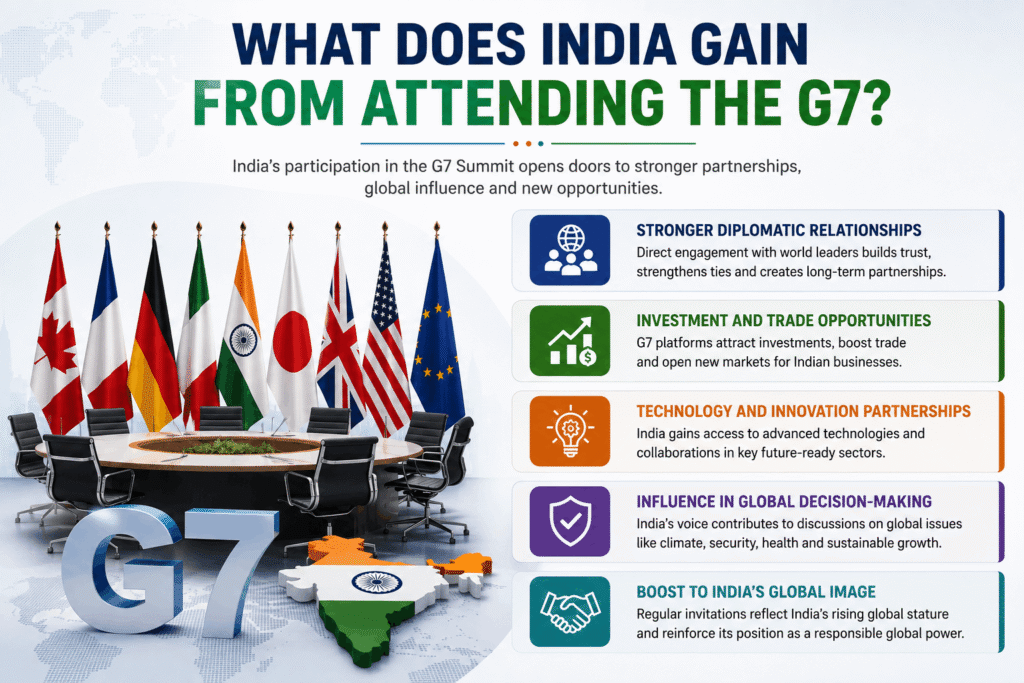
The answer includes stronger diplomatic relationships, investment opportunities, technology partnerships, and greater influence in global decision-making.
Participation gives Indian leaders direct access to discussions with some of the world’s most influential policymakers and business leaders.
According to a News On Air report on India’s discussions at the G7 Summit, topics include economic cooperation, technology, sustainable development, and international security.
While these meetings do not always produce immediate agreements, they often help shape future partnerships and strategic cooperation.
For Indian businesses, entrepreneurs, and investors, stronger international relationships can eventually create new opportunities for growth.
India’s Invitations Reflect a Changing World
The repeated invitations extended to India reveal a larger shift taking place in the global economy.
Economic power is becoming more distributed, and emerging economies are playing a bigger role in shaping international outcomes.
India’s rise is being driven by its expanding economy, growing technological capabilities, manufacturing ambitions, and increasing diplomatic influence.
As a result, many global institutions and forums now recognize that major international challenges cannot be effectively addressed without India’s participation.
Looking ahead, the phrase India invited to G7 is likely to remain in the headlines. As India’s economy and global influence continue to grow, its role in major international discussions is expected to become even more significant.
The Bottom Line
So, why is India invited to G7 despite not being a member?
Because India’s influence now extends far beyond its borders.
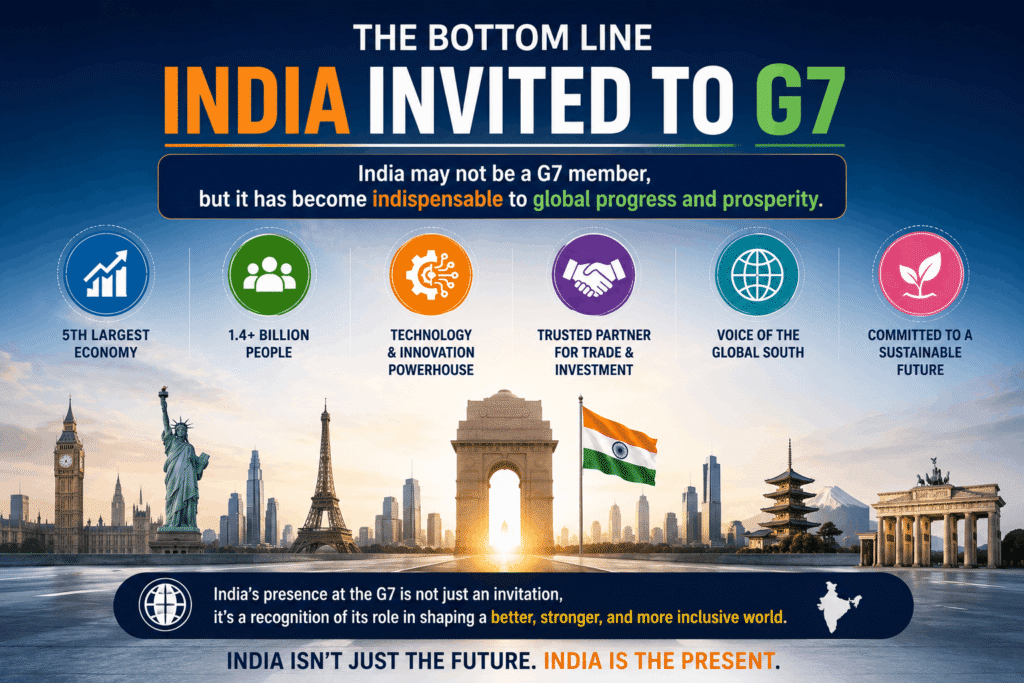
India is the world’s fifth-largest economy, a major technology hub, an increasingly important manufacturing center, a critical supply-chain partner, and a leading voice for the Global South.
That combination makes India an important participant in discussions about trade, technology, energy security, economic growth, and international development.
India may not hold a permanent seat in the G7, but its repeated invitations send a clear message.
India is no longer simply an emerging power. It is becoming one of the countries helping shape the future direction of the global economy.
FAQs
Why is India invited to G7 despite not being a member?
India is invited to the G7 because of its growing economic influence, strategic importance, and role as a representative of the Global South.
Is India a member of the G7?
No, India is not a member of the G7. However, it is frequently invited as a guest country by the summit’s host nation.
How many times has India been invited to the G7?
Prime Minister Narendra Modi has stated that India has been invited to the G7 Summit for eight consecutive years.
What does India gain from attending the G7?
India gains opportunities for diplomatic engagement, investment discussions, technology partnerships, and influence in global decision-making.
Can India become a G7 member in the future?
Currently, the G7 has no formal expansion process. However, India’s growing global influence has led to discussions about broader representation in international institutions.
1 thought on “Why Is India Invited to the G7 Despite Not Being a Member? India’s Growing Global Influence Explained”