
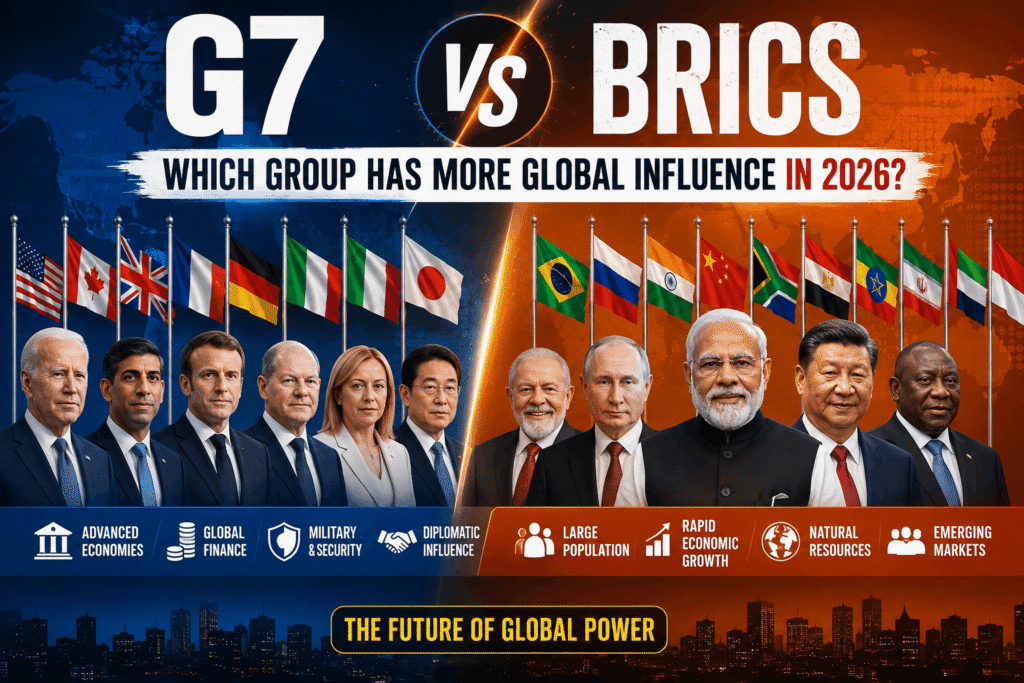
aIf you’ve been following international news lately, you’ve probably noticed two groups appearing in almost every major global discussion: G7 and BRICS.
The G7 Summit recently brought together leaders from some of the world’s richest economies, while India is currently leading BRICS in 2026 and shaping the group’s future agenda.
As global power continues to shift, many Indians are asking an important question:
G7 vs BRICS: Which group has more global influence in 2026?
The answer is not as simple as choosing one winner.
The G7 still dominates global finance, diplomacy, and military influence, while BRICS is rapidly expanding its reach across developing economies, emerging markets, and the Global South.
The debate over G7 vs BRICS has intensified in 2026 as India’s growing role in both forums puts it at the center of global economic and diplomatic discussions.
For India, this debate matters more than ever.
India is currently chairing BRICS while also maintaining strong partnerships with G7 nations. If you’re wondering why India continues to engage with both groups, read our detailed guide on Why Is India Invited to the G7 Despite Not Being a Member?.
What Is the Difference Between G7 and BRICS?
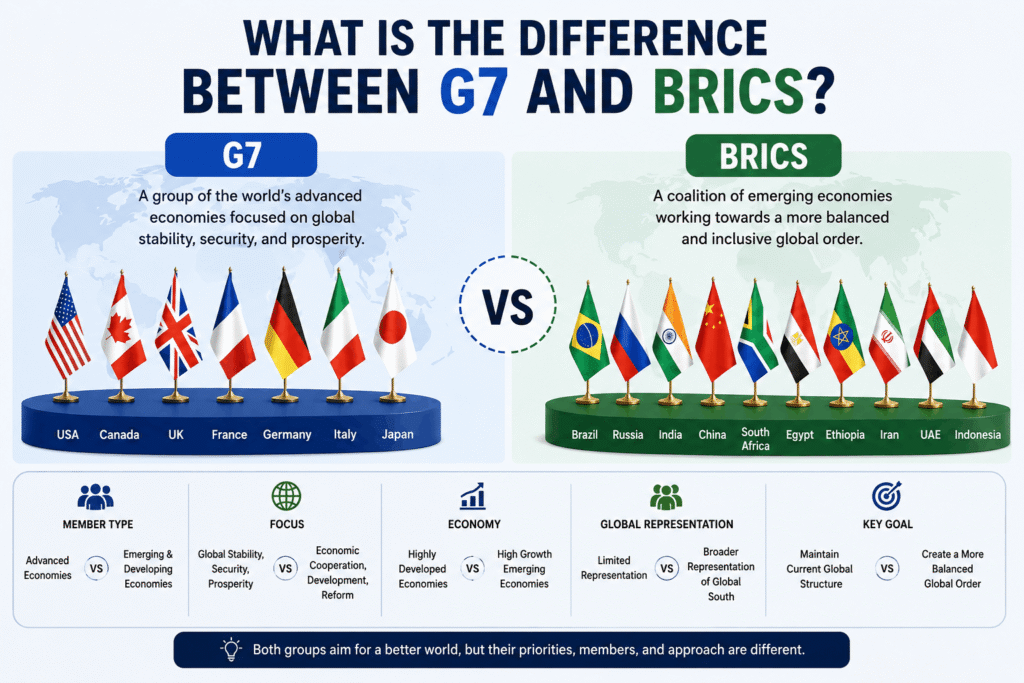
Before comparing influence, it’s important to understand what these two groups actually represent.
The G7 countries list includes:
- United States
- United Kingdom
- Canada
- France
- Germany
- Italy
- Japan
The G7 was originally formed to coordinate economic policies among advanced economies. Over time, it expanded its focus to include international security, trade, climate policy, technology, and global governance.
The BRICS countries list originally included:
- Brazil
- Russia
- India
- China
- South Africa
In recent years, BRICS has expanded significantly beyond its original five members, adding countries such as Egypt, Ethiopia, Iran, the UAE, and Indonesia. This expansion has transformed BRICS into a broader coalition of emerging and developing economies.
According to a recent analysis of India’s BRICS presidency in 2026, India’s challenge is balancing the interests of a growing membership while ensuring BRICS remains focused on economic cooperation and development.
The biggest difference is straightforward.
The G7 represents established economic powers. BRICS represents rising economic powers.
G7 Countries vs BRICS Countries: A Quick Comparison
| Factor | G7 | BRICS |
|---|---|---|
| Member Type | Advanced Economies | Emerging & Developing Economies |
| Population | About 770–780 million | About 4–4.5 billion |
| Global Influence | Finance, diplomacy, military | Growth, resources, population |
| Key Strength | Financial institutions & global capital | Emerging market power & demographics |
| India’s Position | Guest Participant | Founding Member |
This comparison shows why the G7 vs BRICS 2026 debate has become increasingly relevant.
The two groups represent very different sources of global influence.
Which Group Is Economically More Powerful in 2026?
This is where the BRICS vs G7 economy debate becomes especially interesting.
For decades, the G7 dominated the global economy.
The United States remains the world’s largest economy, while Germany and Japan continue to play major roles in manufacturing, exports, and global investment.
The G7 also maintains significant influence over institutions such as the IMF, World Bank, and international financial markets.
However, BRICS has steadily gained ground.
China is the world’s second-largest economy, while India remains one of the fastest-growing major economies. Together, BRICS countries account for a massive share of global manufacturing, energy production, and consumer demand.
You can see this shift in everyday Indian life.
Whether you’re using PhonePe, making payments through UPI, investing with Zerodha, ordering food through Swiggy, or shopping online, you’re participating in an economy that increasingly interacts with other emerging markets across Asia, Africa, and the Middle East.
The shift is already visible in business cooperation. A recent Economic Times report on the first BRICS MSME Forum in Agra highlighted India’s efforts to strengthen trade, innovation, and small-business partnerships across BRICS nations.
Despite this momentum, the G7 still holds an advantage when it comes to global investment flows, banking systems, financial markets, and currency dominance.
The US dollar remains the world’s dominant reserve currency, giving G7 economies significant influence over international finance and trade.
Economically, the G7 remains stronger today, but BRICS is growing faster.
Which Group Has More Political Influence?
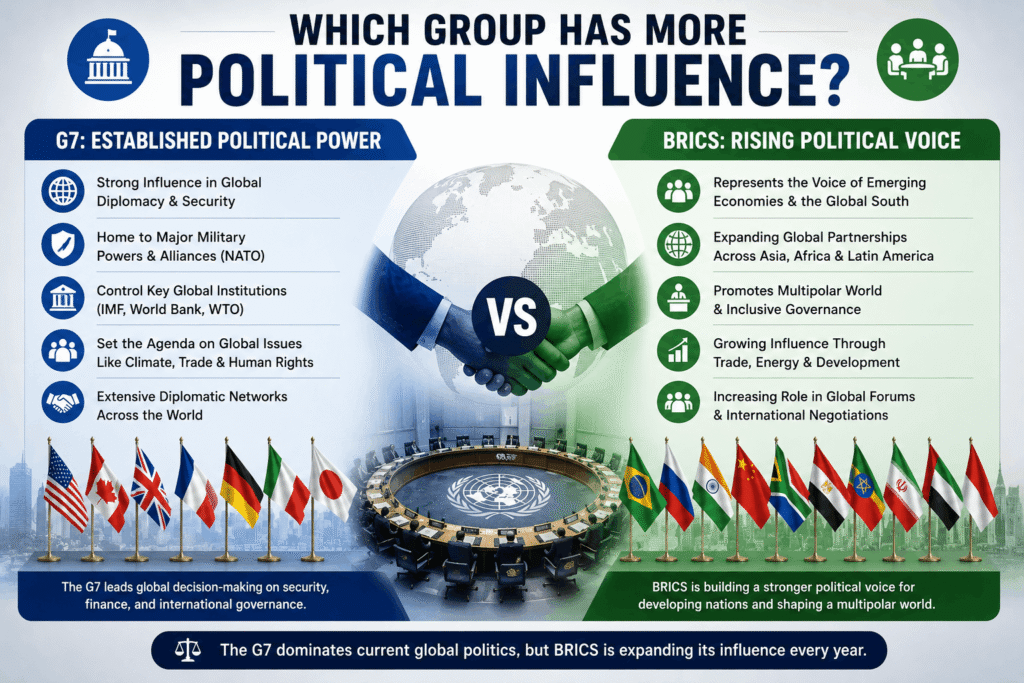
Economic power is only one part of the story.
Political influence is where the competition becomes more complex.
The G7 continues to shape many of the world’s most important diplomatic and security discussions.
This week, G7 leaders focused on Ukraine, global debt challenges, security concerns, and economic stability. According to Reuters coverage of G7 efforts to address debt vulnerabilities, member nations pledged to strengthen support for developing countries facing financial pressure.
Several of the world’s most influential military and diplomatic powers belong to the G7.
This gives the group significant leverage in international affairs.
BRICS takes a different approach.
Rather than focusing primarily on security issues, BRICS emphasizes economic development, infrastructure, trade cooperation, and representation for emerging economies.
Many countries across Africa, Asia, and Latin America see BRICS as a platform that better reflects their priorities.
This growing appeal has helped BRICS expand its international influence.
Why Is BRICS Growing Faster Than the G7?
One reason is demographics.
Many G7 countries face aging populations and slower economic growth.
India, by contrast, continues to add millions of consumers, entrepreneurs, and technology users every year.
Another reason is representation.
Many developing nations believe international institutions created after World War II no longer reflect today’s economic realities.
BRICS has benefited from that perception.
India’s BRICS presidency is already moving beyond diplomatic statements and into practical economic cooperation. The upcoming BRICS MSME Forum in Agra is expected to bring together entrepreneurs, policymakers, and business leaders from across member nations.
For a small manufacturer in Surat, a startup founder in Bengaluru, or a handicraft exporter in Agra, stronger trade relationships across BRICS countries could create real business opportunities.
That practical impact is helping BRICS gain momentum.
What Role Does India Play in G7 and BRICS?
India occupies a unique position in global politics.
Unlike many countries that align primarily with one bloc, India maintains strong relationships with both developed and developing economies.
This gives India significant diplomatic flexibility.
At the G7 Summit this week, Prime Minister Modi emphasized that the Global South should not be left alone to bear the economic consequences of international conflicts. According to Times of India coverage of Modi’s G7 remarks, he argued that rising food, fuel, and fertilizer costs continue to place a heavy burden on developing nations.
At the same time, India is leading BRICS discussions on economic cooperation, innovation, sustainability, and development.
India’s unique position allows it to engage with both developed and emerging economies simultaneously. This balancing act is one reason India continues to receive G7 invitations despite not being a member. We explained the full background in our article on India invited to G7 despite not being a member.
This ability to operate across multiple global platforms has become one of India’s greatest diplomatic strengths.
So, Which Group Has More Global Influence in 2026?
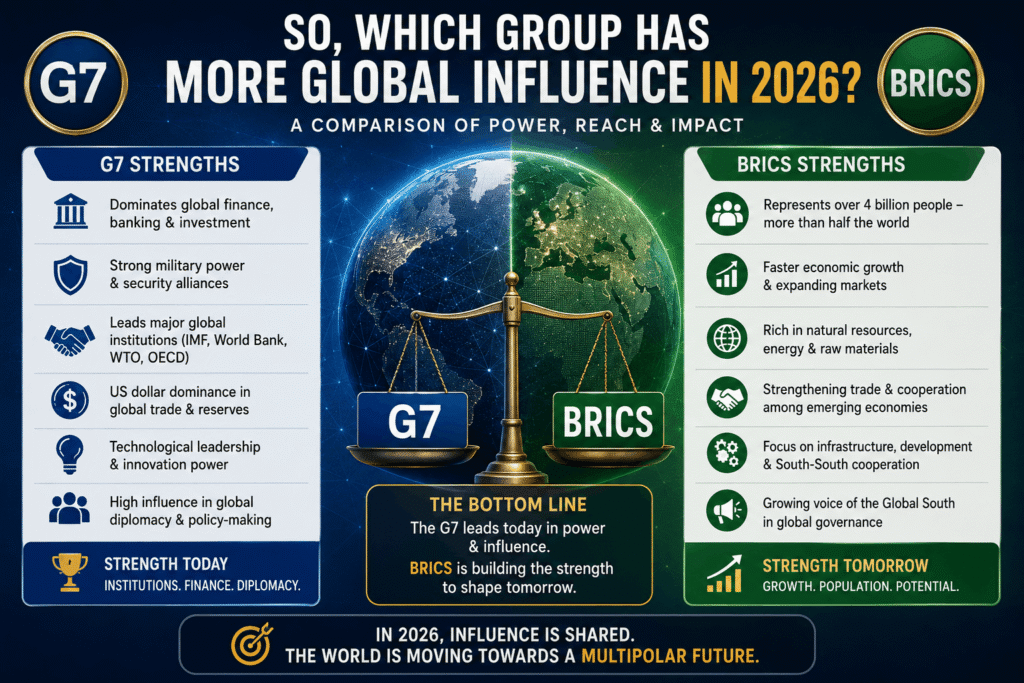
The honest answer depends on how influence is measured.
If you’re looking at:
- Global finance
- International institutions
- Military capabilities
- Currency dominance
- Diplomatic power
Then the G7 still has the advantage.
If you’re looking at:
- Population
- Future economic growth
- Emerging markets
- Natural resources
- Representation of developing countries
Then BRICS is becoming increasingly influential.
The world is becoming more multipolar.
Power is no longer concentrated in a single group of nations.
Instead, influence is increasingly shared across multiple regions, alliances, and economic blocs.
The Bottom Line
The G7 vs BRICS debate is really a debate about how the world is changing.
The G7 remains one of the most powerful blocs on the planet because of its wealth, financial institutions, technological leadership, and diplomatic influence.
At the same time, BRICS is emerging as a major force because of its population, economic growth, natural resources, and ability to represent countries outside the traditional Western-led system.
In 2026, the G7 remains the most influential financial and diplomatic bloc, while BRICS is emerging as the most influential coalition of developing economies.
For India, the real advantage comes from engaging with both groups.
India’s ability to work with advanced economies through the G7 while leading cooperation among emerging nations through BRICS gives it a unique position in global affairs.
Rather than choosing one side, India is increasingly helping shape a world where both blocs play important roles in determining the future of trade, technology, development, and international cooperation.
FAQs
What is the difference between G7 and BRICS?
The G7 consists of advanced economies such as the United States, Germany, and Japan, while BRICS brings together major emerging economies including Brazil, Russia, India, China, and South Africa along with newer members.
Which is more powerful, G7 or BRICS?
The G7 remains stronger in global finance, diplomacy, and military influence. However, BRICS has greater population strength and is growing rapidly in economic and geopolitical importance.
Is BRICS larger than the G7?
Yes. BRICS represents more than 4 billion people, while G7 countries have a combined population of around 770–780 million.
Why is India important in the G7 vs BRICS debate?
India is a founding member of BRICS and also regularly attends G7 summits as a guest nation. This gives India a unique role in both developed and emerging economic blocs.
Can BRICS replace the G7?
At present, BRICS is not replacing the G7. However, it is becoming increasingly influential as more developing countries seek a stronger voice in global affairs.
What is the main goal of BRICS?
BRICS focuses on economic cooperation, trade, development, infrastructure, and representing the interests of emerging economies.